
Table of Contents
Why Marketing Feels Unstable Before It Even Starts
If you are reading this, you are likely not new to marketing. You have invested before—perhaps multiple times. You have run ads, hired agencies, experimented with SEO, tested new platforms, and explored different approaches to gaining visibility. You have not ignored the responsibility of growth. You have engaged it.
And yet, something still feels unsettled.
Perhaps you are currently spending and seeing activity, but the results feel inconsistent. Some months show progress; others feel fragile. Reports arrive, but clarity does not. Revenue may move, but confidence does not fully follow. The effort is real, but stability remains elusive.
Or perhaps you have pulled back. Not because you lack ambition, but because the last investment disappointed you. The strategy sounded reasonable. The spend was justified. The outcome did not match the expectation. What remains is hesitation—not from fear of growth, but from uncertainty about what went wrong.
It is important to say this clearly: you do not lack effort. You do not lack intelligence. You do not lack ambition.
The frustration most experienced business owners feel around marketing is rarely a reflection of incompetence. More often, it is a signal of misalignment. Marketing at this stage of business is no longer just about tactics or platforms. It is intertwined with operations, positioning, capacity, and internal systems. When one of those elements is unclear, the results feel unstable—even if the execution appears sound.
The weight you feel is not confusion about tools. It is the pressure of making responsible decisions with real consequences attached.
The Real Reason Marketing Fails Before It Starts
When marketing underperforms, the explanation often sounds reasonable on the surface. The ads were poorly written. The agency lacked expertise. The algorithm changed. The budget was insufficient. Each of these explanations feels plausible, and in isolation, any one of them can be partially true.
But they are rarely the root cause.
These surface-level diagnoses persist because they are easy to point to. They focus on execution rather than structure. They imply that with the right adjustment—a better campaign, a sharper creative, a more experienced partner—the problem would correct itself. This assumption is comforting because it suggests the solution is tactical.
In reality, marketing frequently fails before the first dollar is ever spent.
It fails when capacity has not been honestly assessed. It fails when positioning remains unclear or indistinct in the marketplace. It fails when the business model is not conversion-ready, or when internal systems cannot reliably support increased demand. It fails when expectations outpace operational reality.
At that point, advertising does not fix the problem. It magnifies it.
Many business owners operate under subtle but powerful assumptions: that more traffic will fix revenue inconsistencies; that a stronger ad can compensate for a weak or undifferentiated offer; that the right agency will “figure it out”; that increased visibility alone will produce stability. These beliefs are understandable, but they are incomplete.
Visibility does not create strength. It amplifies what already exists. Marketing does not manufacture stability. It reveals whether stability is present. Traffic is not a solution; it is pressure applied to the current structure of the business.
If that structure is sound, marketing accelerates growth. If it is fragile, marketing exposes the cracks.
The central reframing is this: marketing does not create stability. It tests it.
The Foundational Truth Behind Why Marketing Fails
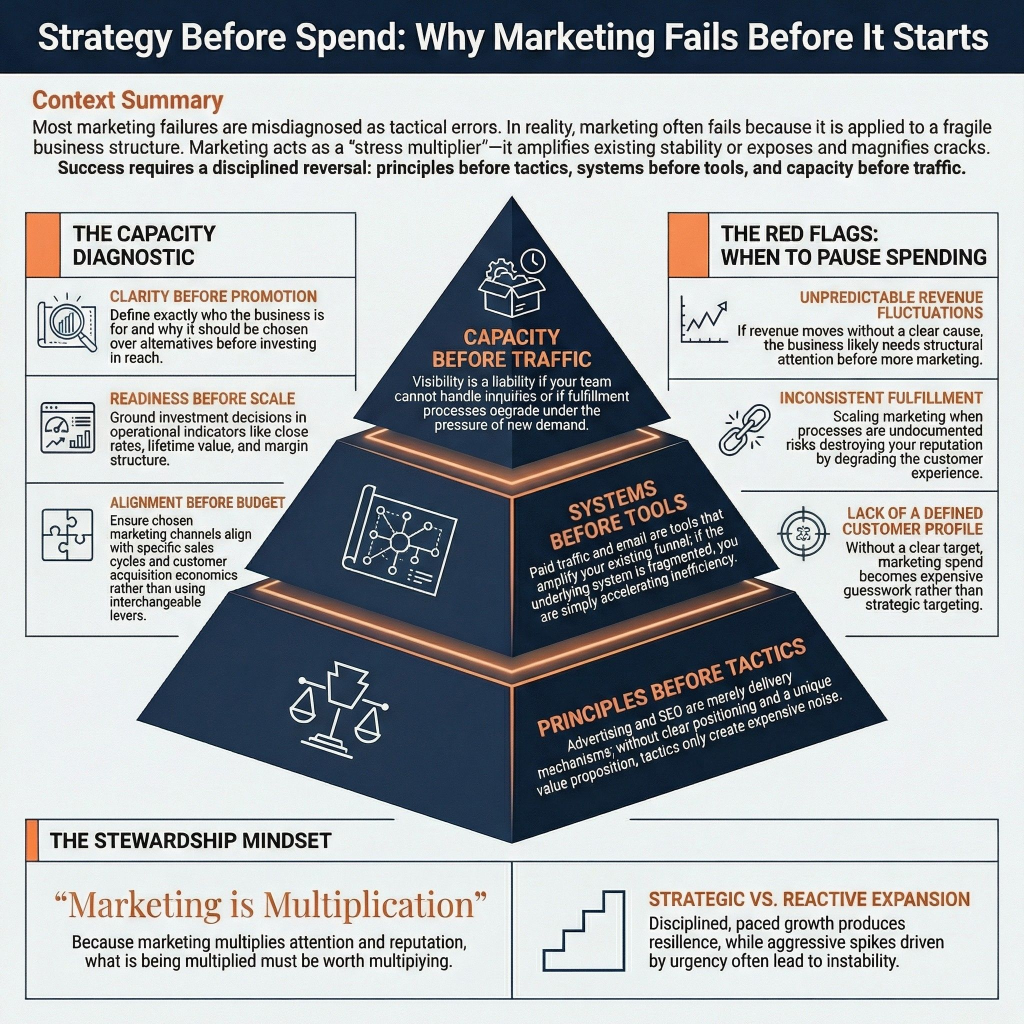
At its core, marketing operates under a simple hierarchy that many businesses unintentionally reverse. When that order is misunderstood, frustration follows. When it is respected, marketing becomes stable and predictable.
The hierarchy is this: principle before tactic, system before tool, and capacity before traffic.
First, principle must come before tactic. Advertising is not strategy. SEO is not positioning. Social media is not differentiation. These are delivery mechanisms. They are vehicles that carry a message and amplify a decision. Without clear principles guiding them—who the business is for, what it uniquely solves, and how it creates value—tactics become disconnected activities. Disconnected activity creates noise. Noise consumes budget. Over time, that burn erodes trust, not only in the agency or the channel, but in marketing itself.
Second, system must come before tool. Tools are powerful, but they are not inherently strategic. Paid traffic amplifies the structure of your funnel. SEO amplifies your authority and relevance. Email amplifies the consistency of your messaging. None of these tools correct structural weaknesses. They magnify them. When the underlying system is sound, amplification accelerates growth. When the system is unclear or fragmented, amplification accelerates inefficiency.
Finally, and most critically, capacity must come before traffic. This is the principle most often overlooked. Before investing in growth, few business owners pause to ask whether the organization is prepared for what success would demand. Can the team handle twice the inquiries without degrading service? Is the sales process consistent and measurable? Are close rates understood? Is retention strong enough to support customer lifetime value? Is the backend profitable?
When these questions go unanswered, marketing becomes an expensive stress multiplier. Increased visibility creates increased demand, but demand without structure introduces strain rather than stability.
The foundational truth is simple: marketing cannot compensate for weak principles, fragmented systems, or limited capacity. It can only reveal them.
What Actually Works Before You Spend on Marketing
If marketing fails when principles are ignored, what actually works is not a new tactic but a different way of thinking. Sustainable growth does not come from pressing better buttons. It comes from asking better questions before any campaign begins.
The first shift is clarity before promotion. Before investing in reach, a business must be clear about who it is actually for, what specific problem it solves, and why it should be chosen over credible alternatives. Many marketing struggles trace back to indistinct positioning rather than poor execution. When messaging lacks clarity, promotion simply amplifies confusion. Clear positioning, by contrast, reduces friction in every channel. Promotion then becomes reinforcement rather than persuasion.
The second shift is readiness before scale. Growth places pressure on systems, not just budgets. Experienced operators benefit from understanding their close rate, lifetime value, fulfillment consistency, and margin structure before increasing demand. These metrics are not marketing vanity; they are operational indicators. Without them, scaling becomes guesswork. With them, investment decisions become grounded and measurable. Marketing should enter an environment prepared to absorb and convert attention, not one still defining its fundamentals.
The third shift is alignment before budget. Not every channel fits every business model. A local service company operates differently from a national ecommerce brand. High-ticket consulting behaves differently than impulse consumer products. Marketing channels are not interchangeable levers. They must align with sales cycles, buying behavior, and customer acquisition economics. Many agencies skip this conversation because it slows the sales process. However, without alignment, even well-managed campaigns can underperform.
Finally, stewarded growth must replace aggressive growth. Sustainable expansion outperforms sudden spikes. Marketing should clarify margins, strengthen retention, and reinforce systems over time. When growth is pursued reactively—driven by urgency rather than structure—it introduces instability. Strategic expansion, paced and measured, produces resilience.
What works, ultimately, is disciplined thinking. Marketing becomes effective not when it is louder, but when it is aligned, measured, and integrated with the realities of the business it supports.
Marketing Readiness: The Capacity Check Most Businesses Skip
Not every business is in the same season. Marketing does not exist in a vacuum, and it does not solve foundational instability. For that reason, it is important to define clearly who this perspective is intended for—and who may need to pause before investing further.
This article is written for established small businesses and ecommerce brands that already have consistent demand or clear product-market fit. It is for owners who are currently investing in marketing, or who are preparing to do so responsibly. It is for leaders who understand that sustainable growth is built on systems, not shortcuts, and who value long-term clarity over immediate spikes.
When those conditions are present, marketing becomes a lever for acceleration. When they are not, it becomes a magnifier of strain.
There are situations where increasing marketing activity should be delayed. If revenue fluctuates unpredictably from month to month without clear cause, structural stability may need attention first. If the offer itself is unclear or inconsistently positioned, promotion will only amplify confusion. If there is no defined customer profile, targeting becomes guesswork. If fulfillment processes are inconsistent or undocumented, increased demand risks degrading customer experience. And if the expectation is an immediate return without operational refinement, disappointment is almost guaranteed.
None of these realities are judgments. They are indicators of sequence. Growth must follow readiness, not precede it.
Before scaling any marketing effort, experienced operators benefit from asking a few disciplined questions. If lead volume doubled tomorrow, what would break first—sales, onboarding, fulfillment, customer support? Do we know our breakeven acquisition cost with confidence? Are we measuring actual revenue performance, or are we reacting to surface-level metrics that look encouraging but lack depth? Are we meeting genuine market demand, or are we attempting to manufacture urgency where demand is weak?
These questions do more than protect budget. They protect stability. They signal whether marketing will strengthen the business—or simply expose its weakest points.
Clarity at this stage is not a delay. It is preparation.
A Stewardship Perspective on Marketing Growth
Marketing is, at its core, multiplication. It multiplies attention, amplifies reputation, and increases demand. Because of that, it carries weight. What is multiplied must be worth multiplying.
In practical terms, growth without structure becomes waste. Exposure without integrity becomes risk. Revenue without discipline can erode judgment rather than strengthen it. Marketing does not simply increase activity; it increases consequence. The more visible a business becomes, the more pressure it places on its systems, its team, and its promises.
A stewardship-oriented perspective approaches growth differently. It treats capital as something to protect, not merely deploy. It views reputation as an asset that must be reinforced, not tested recklessly. It respects team capacity rather than stretching it to the breaking point in pursuit of short-term numbers. And it understands that responsible expansion outperforms reactive expansion over time.
This posture is not about slowing progress. It is about ensuring that progress strengthens the business rather than destabilizes it. When marketing is approached with this mindset, decisions become measured instead of impulsive. Expectations become realistic instead of inflated. Growth becomes intentional rather than accidental.
At that point, marketing stops being a gamble. It becomes a disciplined extension of how the business already chooses to operate.
Before You Invest in Marketing: Start With Clarity
If you are already investing in marketing—or preparing to—the next step is not necessarily more activity. It is clarity.
Before increasing budget, launching new campaigns, or switching platforms, it is worth understanding what is structurally happening beneath the surface. Where is alignment strong? Where is it fragile? Where would additional demand create stability, and where would it introduce strain?
Our Competitive Marketing Analysis is designed as a diagnostic, not a pitch. It evaluates positioning, assesses capacity, and examines how current marketing efforts align with operational reality. The goal is not to recommend more spending. It is to determine whether additional investment would strengthen the business or simply amplify existing weaknesses.
This process includes a review of how your offer is positioned, how demand flows through your current systems, and how well those systems convert and retain value. For businesses that are serious about growth, this clarity often proves more valuable than any single tactic.
If a formal analysis feels premature, a Clarity Call is available as a starting point. This is not a sales conversation framed as strategy. It is a thinking conversation—an opportunity to pressure-test assumptions, ask disciplined questions, and determine whether there is a strong mutual fit.
If we are aligned, we will build something structured and sustainable. If not, you will leave with clearer direction than you started with.
Growth should begin with understanding, not urgency.