
Table of Contents
Why HVAC Marketing Matters More Than Ever
Most HVAC companies don’t struggle because there aren’t enough homeowners who need heating and cooling work. Air conditioners break, furnaces fail, and systems eventually age out and require replacement in every market. The real challenge most contractors face isn’t demand itself — it’s the consistency of demand.
Many HVAC businesses rely on a mixture of referrals, seasonal spikes, and occasional advertising to generate work. Some months the phones ring constantly and the schedule fills up quickly. Other months the board suddenly opens up and the team starts wondering how they’re going to keep technicians busy. This kind of unpredictability rarely comes from the market alone. More often, it comes from marketing systems that were never designed to produce steady, reliable opportunities.
At the same time, the competitive landscape in the HVAC industry has changed significantly over the past decade. Competition has increased in many markets, digital advertising costs continue to rise, and private equity–backed consolidators are entering the space with larger budgets and more sophisticated growth strategies. These changes have made marketing a much more important part of running a successful HVAC company than it was in the past.
Customer behavior has also shifted. Today, most homeowners begin their search for a contractor online. Instead of relying on phone books, newspaper ads, or other traditional media, customers typically discover HVAC companies through Google searches, Google Maps, online reviews, and other digital channels. Visibility in these platforms now plays a major role in determining which companies get the call when a homeowner needs help.
For growth-stage HVAC companies — often generating between $3 million and $10 million in annual revenue — marketing becomes one of the primary drivers of sustainable growth. The difference between constantly chasing the next job and building a predictable pipeline of work often comes down to whether the company has developed a structured marketing system.
This guide explains how HVAC marketing actually works in today’s environment. We’ll look at where HVAC leads really come from, which marketing channels tend to produce the highest-quality customers, how much HVAC companies typically invest in marketing, and how contractors can build systems that generate consistent demand over time. Understanding these fundamentals can help HVAC operators move beyond reactive marketing and begin building a reliable growth engine for their business.
How HVAC Companies Actually Grow
Before diving into marketing tactics, it’s important to understand how HVAC companies actually grow from an economic perspective. Marketing strategies only make sense when they align with the way revenue is generated inside the business.
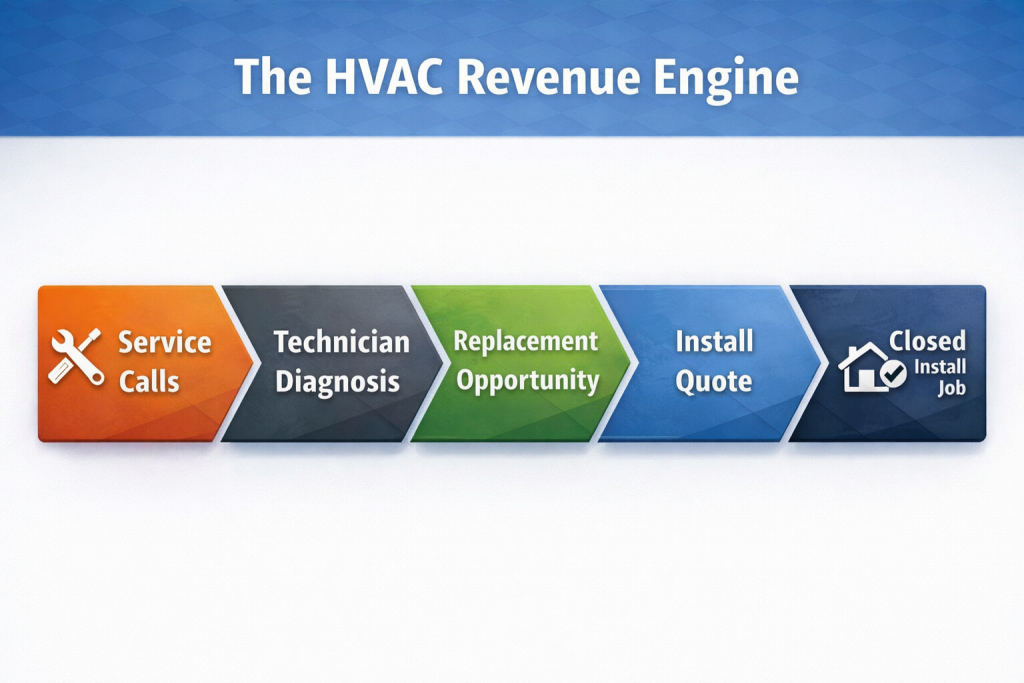
Most residential HVAC companies generate revenue from two primary categories: service and repair work, and installation or system replacement. Service and repair work includes diagnostic calls, repair jobs, and ongoing maintenance. These calls are typically triggered by immediate problems — a system not cooling, a furnace not turning on, or a homeowner needing a seasonal tune-up. Because the homeowner already has a clear need, service calls tend to have very high completion rates once scheduled. In many HVAC operations, companies target closed call rates of 85% or higher, meaning most booked appointments result in a completed service visit.
However, while service calls provide steady workflow, they usually generate relatively modest ticket sizes compared to system replacements. Industry research suggests the average residential service ticket is around $390, which helps keep technicians productive but doesn’t typically drive major revenue growth by itself.
The second major revenue driver is installation and replacement work, which includes air conditioner replacements, furnace replacements, heat pump installations, and full system upgrades. These projects generate significantly larger revenue per customer and are often where the majority of profit is produced in many HVAC businesses. Unlike service calls, however, installation work involves a sales process. After a technician identifies a failing system or a homeowner requests a replacement estimate, the company must present options and earn the job.
Industry data suggests that HVAC contractors close roughly 43–45% of installation opportunities, meaning that fewer than half of replacement proposals ultimately become completed projects. This dynamic is important because it highlights how the growth of an HVAC company is influenced not only by how many leads are generated, but also by how effectively those opportunities convert into installation revenue.
For this reason, the role of marketing in an HVAC company goes beyond simply generating service calls. While service demand keeps the schedule full and technicians working, effective marketing systems also create opportunities for replacement jobs, system upgrades, and higher-value work. Companies that understand this relationship between service demand and installation revenue are often better positioned to build marketing strategies that support long-term growth.
Where HVAC Leads Really Come From
Many HVAC owners assume that marketing is mostly about advertising. When business slows down, the instinct is often to increase ad spend or try a new promotional campaign. While advertising certainly plays an important role, the reality is that HVAC demand rarely comes from a single source.
Instead, most successful HVAC companies generate opportunities through a mix of multiple lead channels working together. Some of these leads come from marketing activities, while others come from relationships the company has already built with customers over time. When viewed together, these channels create the overall flow of opportunities that keeps technicians busy and generates installation work.
For a typical growth-stage HVAC company, the distribution of opportunities often looks something like this:
| Lead Source | Typical Share of Opportunities |
| Existing customers & maintenance plans | 20–35% |
| Referrals / word of mouth | 15–30% |
| Google Business Profile / Google Maps | 10–20% |
| Google Local Services Ads | 10–20% |
| Google Search Ads | 5–15% |
| Organic SEO traffic | 5–15% |
| Direct traffic / brand searches | 3–8% |
| Social media | 1–5% |
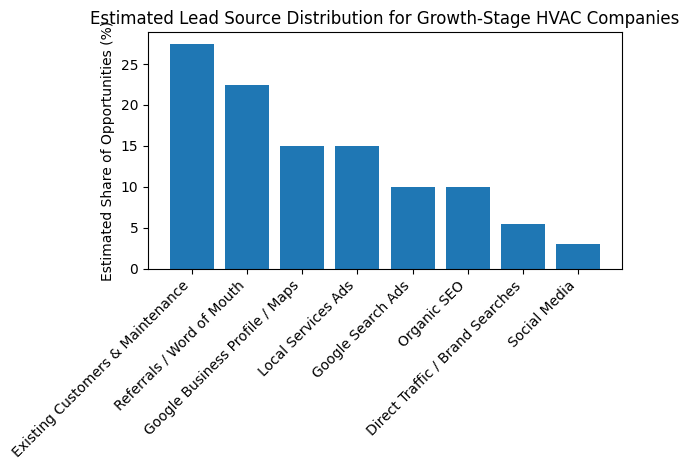
This mix reflects the way homeowners typically find HVAC contractors today. Many customers return to companies they’ve used before, especially if they have a maintenance agreement in place. Others rely on recommendations from friends, neighbors, or online reviews. At the same time, a large portion of new demand now comes from Google search behavior, including map listings, paid ads, and organic search results.
Understanding where leads originate is one of the first steps in building a reliable marketing system. For HVAC companies that want to model their own demand mix, the HVAC Growth Forecast Calculator can help estimate lead flow and revenue potential.
What this distribution reveals is an important strategic insight: the strongest HVAC companies don’t depend on a single source of leads. Instead, they build a marketing system where multiple channels work together to create steady demand. Referrals reinforce reputation. Reviews improve map visibility. Paid advertising captures urgent searches. SEO builds long-term visibility.
When these channels work together, they form a more stable pipeline of opportunities. Companies that rely too heavily on only one or two lead sources often experience unpredictable demand, while those that develop a broader demand system tend to produce more consistent growth over time.
The HVAC Marketing Channels That Drive Real Demand
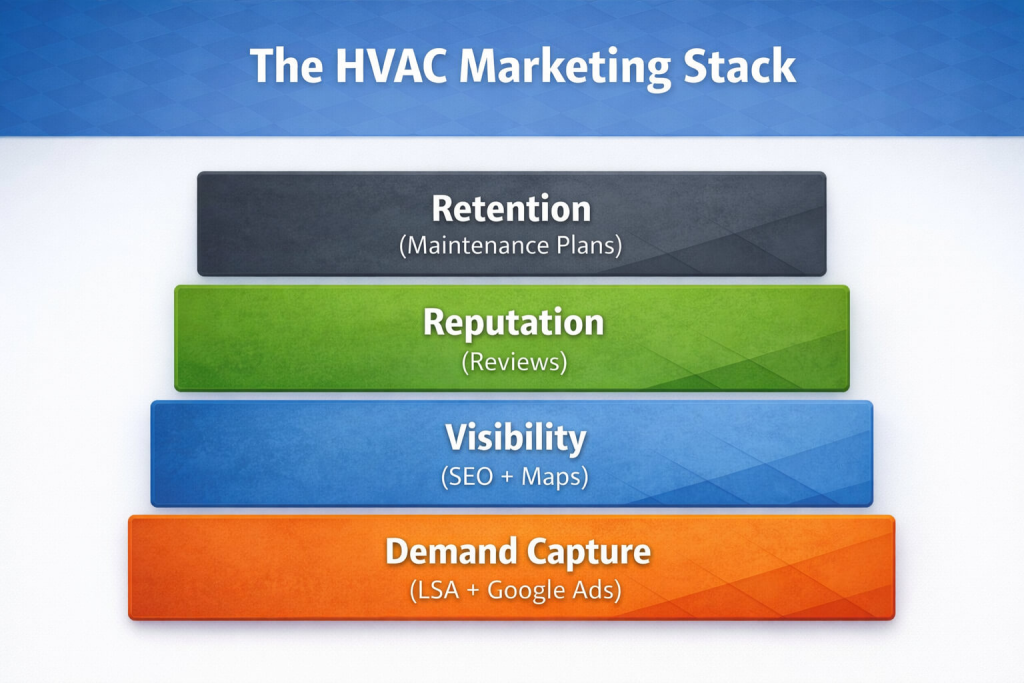
Modern HVAC marketing is built around a handful of core channels that consistently generate demand. While every market and company will see slightly different results, most growth-stage HVAC businesses rely on the same core digital platforms to capture homeowners who are actively searching for help.
Understanding how each of these channels works — and how they fit together — is critical for building a reliable marketing system.
Google Local Services Ads
Google Local Services Ads (often called LSAs) appear at the very top of Google search results for many home service searches. These ads typically appear above traditional Google Ads and the map results, making them one of the most visible placements available to HVAC contractors.
LSAs are often considered among the highest-intent leads because homeowners clicking on them are usually ready to contact a contractor immediately. These searches often occur when a system has stopped working or when a homeowner urgently needs service.
Industry benchmarks provide some helpful context for how LSAs perform in the HVAC industry. In large datasets of home service advertisers, the median monthly LSA spend is approximately $4,277, and the typical cost per lead often falls between $50 and $90, depending on the level of competition in a particular market.
Unlike traditional search advertising, LSA rankings are not determined solely by bid levels. Google evaluates several factors when determining which businesses appear at the top of the results. These factors include review ratings, responsiveness to incoming leads, business availability, and the overall strength of the company’s profile. Contractors who consistently answer calls quickly and maintain strong review profiles tend to perform significantly better in this channel.
Google Business Profile and the Map Pack
Google Maps — often referred to as the Map Pack in search results — is one of the most important organic lead sources for HVAC companies. When homeowners search for phrases like “AC repair near me” or “HVAC company nearby,” Google frequently displays a map with several local businesses listed directly beneath it.
For many contractors, this section of the search results generates a significant portion of inbound calls. In some large home services datasets, Google Business Profile listings have been associated with more than half of organic closed revenue, demonstrating how influential map visibility can be in local markets.
Google determines map rankings using three primary factors: relevance, proximity, and prominence. Relevance refers to how closely a business profile matches the user’s search. Proximity relates to the geographic distance between the searcher and the business. Prominence reflects the overall authority and reputation of the company.
Reviews play a major role in this visibility. Companies with stronger review profiles, higher ratings, and consistent customer feedback tend to perform better in the Map Pack because reviews contribute to the prominence signals Google evaluates when ranking local businesses.
Google Search Ads
Google Search Ads allow HVAC companies to capture demand for homeowners actively searching for services such as “AC repair near me,” “furnace replacement,” or “emergency HVAC repair.” These searches typically represent urgent or high-intent situations, which is why search advertising has become one of the most widely used marketing channels in the industry.
Across large home-services advertising datasets, typical benchmarks for HVAC-related search campaigns include cost-per-click levels around $9–$10, conversion rates of roughly 6–7%, and cost per lead ranges that often fall between $100 and $200 or more depending on the market.
Successful HVAC advertisers typically structure their campaigns around different types of search intent. Rather than running a single blended campaign, many companies separate campaigns into categories such as branded searches versus non-branded searches, repair-related queries versus replacement-related queries, and heating versus cooling services. This segmentation allows the business to measure performance more accurately and optimize spending based on the true value of each type of lead.
For a deeper look at how HVAC Google Ads strategy impacts lead quality and conversion, this guide walks through it step by step.
SEO (Search Engine Optimization)
Search Engine Optimization, or SEO, focuses on building long-term organic visibility in Google search results. While paid advertising can generate immediate traffic, SEO helps companies attract homeowners who are searching for information or services without paying for every click.
Unlike paid ads, organic traffic tends to compound over time as websites build authority and publish more relevant content. Large datasets analyzing HVAC and home-services websites show that organic search can account for roughly 42% of unique leads within digital attribution models, highlighting the significant role SEO can play in long-term demand generation.
High-performing HVAC SEO strategies usually focus on several types of pages. Service pages target specific offerings such as AC repair or furnace installation. Location pages help businesses rank for searches in the cities and service areas they cover. Repair and replacement queries capture homeowners actively searching for help. Educational content can also support these efforts by addressing common homeowner questions about HVAC systems.
However, SEO should be viewed as a long-term investment rather than a quick fix. It often takes several months for new content and optimization efforts to begin producing meaningful results. Companies that remain consistent with SEO over time are more likely to build durable organic visibility that continues generating leads well into the future.
How Much HVAC Companies Should Spend on Marketing
One of the most common questions HVAC owners ask is simple: How much should we actually be spending on marketing?
HVAC owners who want to estimate their own marketing investment can use the HVAC Marketing Budget Planner to model revenue levels and recommended budget ranges.
While every company’s situation is different, industry research provides useful benchmarks that help contractors understand what other growth-stage HVAC businesses are investing to generate demand. Most HVAC marketing budgets are typically calculated as a percentage of annual revenue rather than as a fixed monthly amount.
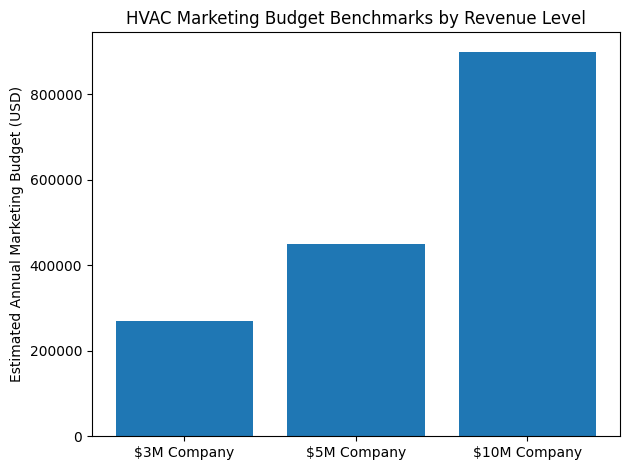
Across contractor surveys and industry benchmarking studies, marketing spending for residential HVAC companies generally falls into three broad ranges depending on the company’s growth goals. Companies focused on maintaining their current level of business often spend around 5% of annual revenue on marketing. Businesses that are aiming for moderate growth commonly invest 8–10% of revenue, while companies pursuing aggressive expansion — such as entering new markets or rapidly increasing installation volume — may invest 12–14% of revenue into marketing and customer acquisition.
These percentages translate into significant marketing budgets as HVAC companies grow. For example, a company generating approximately $3 million in annual revenue may invest around $240,000 to $300,000 per year in marketing if it is targeting steady growth. A $5 million company might allocate roughly $400,000 to $500,000 annually, while a $10 million HVAC company could invest anywhere from $800,000 to $1 million or more per year depending on its growth strategy.
For many established HVAC companies, a large portion of this budget is directed toward digital lead generation channels. These commonly include Google Search Ads to capture high-intent demand, Google Local Services Ads to appear at the top of local search results, and ongoing SEO investments to build long-term visibility in search engines. In addition, many companies allocate marketing resources toward customer retention efforts such as maintenance plan promotions, follow-up campaigns, and review generation systems that strengthen long-term demand.
Determining the right marketing investment level is one of the most important strategic decisions HVAC owners make. For a deeper breakdown of real-world contractor spending data and growth benchmarks, see our guide on HVAC Marketing Budget Benchmarks for Growing Companies.
Ultimately, the exact marketing budget for any HVAC company will depend on its goals, capacity, and market conditions. However, understanding these industry benchmarks can help contractors set realistic expectations about the level of investment typically required to generate consistent growth.
The Biggest Marketing Mistakes HVAC Companies Make
Many HVAC companies struggle with marketing not because they are doing nothing, but because they are making a few common strategic mistakes. These mistakes often lead to inconsistent lead flow, wasted marketing budgets, and frustration with the results of advertising campaigns.
Understanding these pitfalls can help contractors avoid the most common problems and build marketing systems that perform more reliably over time.
Focusing Only on Lead Volume
One of the most common marketing mistakes HVAC companies make is focusing primarily on the number of leads generated rather than the quality of those leads. While it may feel productive to increase call volume, not all leads produce the same business outcomes.
A low-quality lead that results in a price shopper, an unqualified customer, or a job that never gets booked can consume time and marketing dollars without producing meaningful revenue. High-quality leads, on the other hand, typically come from homeowners who are actively searching for service, trust the company’s reputation, and are ready to move forward with work. For this reason, successful HVAC marketing strategies prioritize lead quality and intent, not just lead quantity.
Many HVAC companies focus heavily on increasing lead volume, but volume alone rarely produces better results. In many cases, the real issue is demand quality. We explore this concept further in Why HVAC Lead Quality Matters More Than Lead Volume.
Ignoring Booking Process Efficiency
Marketing performance is not determined solely by the cost of a lead. What happens after the phone rings is just as important. Many HVAC companies focus heavily on reducing cost per lead while overlooking their internal booking process.
If calls go unanswered, response times are slow, or scheduling procedures are inconsistent, a large percentage of potential opportunities can be lost before they ever reach a technician. Even small improvements in booking rates can dramatically improve overall marketing performance. When more leads convert into scheduled service calls, the same marketing budget produces more revenue without increasing advertising spend.
Underinvesting in Reviews
Online reviews have become one of the most powerful factors influencing HVAC marketing performance. Reviews affect both visibility and customer trust. Search platforms such as Google use review quantity, rating, and activity as part of the signals that determine local rankings. At the same time, homeowners rely heavily on reviews when deciding which contractor to contact.
Companies that consistently generate positive reviews often rank higher in map results and experience stronger conversion rates when potential customers compare providers. Businesses that neglect review generation may find themselves at a disadvantage even if they are investing heavily in advertising.
Treating Marketing as a Seasonal Activity
HVAC demand naturally fluctuates throughout the year as heating and cooling seasons change. However, many companies make the mistake of turning marketing on and off based on these seasonal cycles.
When marketing efforts stop during slower periods, visibility and momentum can decline quickly. Search rankings drop, review activity slows, and brand awareness fades. When demand spikes again, the company must rebuild its presence from scratch.
The most successful HVAC companies treat marketing as a continuous system rather than a seasonal tactic. While budgets may increase during peak seasons, the underlying marketing infrastructure — advertising, SEO, reputation management, and customer communication — continues operating year-round. This consistency helps companies maintain visibility and capture demand whenever homeowners need service.
The HVAC Marketing Flywheel
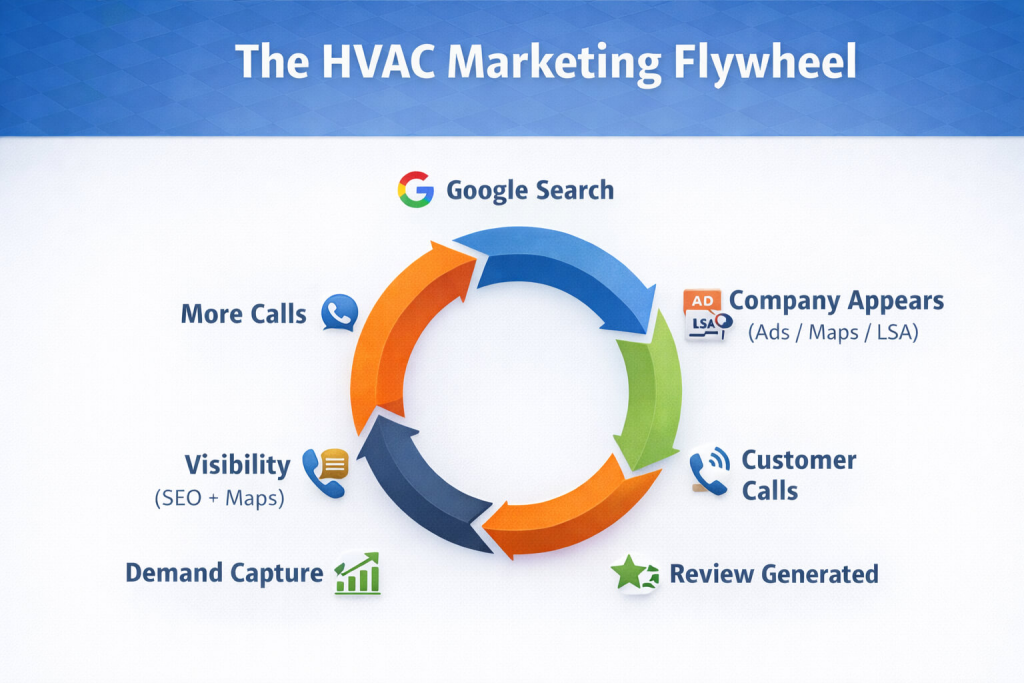
The most successful HVAC companies don’t treat marketing as a series of disconnected tactics. Instead, they build systems where each part of the customer experience reinforces the next. Over time, this creates what can be thought of as a marketing flywheel—a cycle where strong service, reputation, and visibility continually generate new opportunities.
The process often begins when a homeowner searches Google for help with a heating or cooling issue. If the company has built strong visibility through Local Services Ads, Google Maps listings, or search advertising, it appears prominently in those results. This visibility gives the homeowner a reason to call or request service.
Once the call is booked and a technician arrives, the next stage of the flywheel depends on delivering a strong customer experience. When the service visit is handled professionally and the homeowner feels confident in the work that was performed, they are far more likely to leave a positive review after the job is completed.
Those reviews then begin to influence the company’s visibility in search platforms. Reviews contribute to the prominence signals used in local search rankings, and they also serve as powerful trust indicators for future customers evaluating their options. Over time, companies with strong review profiles tend to appear more frequently in map results and attract higher engagement from homeowners comparing contractors.
As visibility increases, the company receives more calls, which creates more opportunities to deliver excellent service and generate additional reviews. This cycle repeats, gradually strengthening the company’s reputation and increasing the volume of inbound demand.
When this flywheel is working properly, marketing becomes more efficient over time. Each satisfied customer contributes to the company’s visibility and credibility, making it easier to generate the next call without constantly increasing advertising spend.
Building a Predictable HVAC Demand Engine
When HVAC marketing is structured properly, it becomes far more predictable than many contractors expect. Instead of relying on seasonal luck, word-of-mouth fluctuations, or occasional advertising campaigns, successful companies build systems that consistently generate opportunities.
The strongest HVAC businesses typically combine several key components that work together to create steady demand.
The first component is demand capture. This includes marketing channels that connect the company with homeowners who are actively searching for service right now. Platforms such as Google Search Ads and Google Local Services Ads allow contractors to appear in front of customers at the exact moment they need help.
The second component is visibility. Long-term visibility is built through organic search results and local map rankings. Search engine optimization and a well-managed Google Business Profile help companies appear in search results even when they are not paying for every click. Over time, these channels can become some of the most consistent sources of inbound leads.
The third component is reputation. Reviews and brand trust play a major role in both search rankings and customer decision-making. Companies that consistently generate positive customer feedback often see higher visibility in local search results and stronger conversion rates when homeowners compare providers.
The fourth component is retention. Maintenance agreements, repeat customers, and follow-up communication help transform one-time service calls into long-term relationships. These customers often become a reliable source of future service calls, replacement opportunities, and referrals.
When these elements work together, they create a marketing system that produces a steady flow of opportunities. Rather than relying on a single tactic, the company develops a demand engine that generates leads from multiple sources and supports long-term growth.
The Future of HVAC Growth Is Built on Marketing Systems
The HVAC industry is becoming more competitive every year. As more contractors enter the market and digital platforms continue to shape how homeowners search for services, marketing is playing an increasingly important role in business success.
Companies that treat marketing as an afterthought often struggle with unpredictable demand. They may experience short bursts of activity followed by slow periods that make scheduling and growth difficult to manage.
In contrast, companies that build structured marketing systems gain a significant advantage. By investing in visibility, reputation, and demand capture channels, they position themselves where homeowners are already searching for help. They create systems that convert more inbound calls into booked work and generate the installation opportunities that drive revenue growth.
For growth-stage HVAC companies, marketing is no longer optional. It has become one of the most important drivers of long-term stability and expansion. Businesses that take the time to build these systems today are far more likely to create predictable demand and sustainable growth in the years ahead.