
Table of Contents
If you’ve been in business for more than a few years, this probably feels familiar.
You’ve tried things.
You’ve hired help.
You’ve spent real money — not “test” money, but money that had other jobs it could’ve been doing.
And yet, marketing still feels inconsistent.
Some months look promising. Others feel fragile. Results show up, then disappear. A tactic works… until it doesn’t. Reports come in, but they don’t always translate into confidence or clarity. You’re left wondering whether the problem is execution, strategy, timing, or something deeper you can’t quite put your finger on.
That frustration is normal — and it’s not a reflection of your effort or intelligence.
Most experienced business owners aren’t failing at marketing because they’re lazy, behind, or missing the latest trick. They’re struggling because the foundations underneath their marketing were never clearly defined, aligned, or stewarded as the business grew.
What worked when the company was smaller doesn’t automatically scale.
What felt “good enough” early on becomes a liability once payroll, reputation, and momentum are on the line.
When marketing decisions are made without a clear framework — without an agreed-upon definition of success, capacity, and responsibility — even good tactics produce shaky outcomes.
At this stage, marketing stops being about ideas and starts being about responsibility.
Responsibility to your team.
Responsibility to your customers.
Responsibility to the resources you’re deploying and the growth you’re inviting in.
That’s the context this conversation is written from.
Not theory.
Not beginner advice.
Not surface-level optimization.
This is written for businesses past the starter phase — businesses that feel the weight of real decisions, real tradeoffs, and real consequences.
We’re not here to impress you with jargon or trends.
We’re here to slow the conversation down just enough to clarify what actually matters — so the marketing you build is steady, intentional, and worthy of the business you’re responsible for.
What We Mean by “Marketing Foundations”
Marketing foundations are the principles, systems, and constraints that govern how marketing decisions are made as a business grows.
They define:
– how strategy is chosen
– how success is measured
– how capacity is respected
– how growth is paced responsibly
Without clear marketing foundations, tactics operate in isolation. Tools replace judgment. Activity replaces direction.
With foundations in place, marketing becomes intentional instead of reactive — and growth becomes something the business can sustain, not just survive.
Why Marketing Still Feels Confusing After You’ve “Done Everything Right” (and Why Foundations Matter More Than Tactics)
Marketing confusion tends to persist for one simple reason: most businesses don’t realize what they’re actually trying to fix.
By the time an owner reaches this stage, they’ve already “done marketing.” They’ve run ads. Posted on social. Hired an agency or a freelancer. Maybe even switched providers once or twice. The effort has been real — and so has the spend.
When results stay inconsistent, the natural conclusion is that something specific must be wrong.
The channel wasn’t right.
The tool wasn’t right.
The agency wasn’t right.
So the solution becomes another swap. Another experiment. Another handoff.
This leads to one of the most common — and costly — beliefs in modern marketing:
“If I just pick the right channel, tool, or partner, this will finally fix itself.”
But marketing rarely fails because the wrong thing was chosen. It fails because everything is operating in pieces.
Fragmented platforms.
Fragmented decisions.
Fragmented accountability.
Ads are running without a clear understanding of what the business can actually support. Content is created without knowing what outcome it’s meant to drive. SEO efforts exist in isolation from sales conversations. Social media activity fills time, but not gaps in the business.
None of this happens because owners aren’t thinking. It happens because there is no governing system tying marketing effort to business capacity and desired outcomes.
Without that system, decisions become reactive.
A dip in leads triggers more ad spend.
Slow months trigger more content.
Pressure triggers activity.
And activity starts to masquerade as progress.
More traffic is mistaken for growth.
More output is mistaken for momentum.
Delegation is mistaken for relief — when in reality, it often becomes abdication of strategic thinking.
Marketing becomes busy, not effective.
This is where most competitive messaging stops. Others point to surface symptoms — low conversions, poor targeting, weak creative — and offer tactical fixes. Those may help temporarily, but they rarely stabilize the system.
The real problem isn’t execution.
It’s structure.
Until marketing is governed by a clear framework — one that connects effort to capacity, capacity to outcomes, and outcomes to responsibility — even good work produces fragile results.
That’s why confusion persists. Not because businesses are doing nothing, but because they’re doing too many disconnected things without a system to hold them together.
The Marketing Foundations That Govern Everything Else
At this stage of business, marketing stops responding to effort and starts responding to structure.
That’s the shift most owners feel but rarely see articulated.
What actually stabilizes marketing — and allows it to compound — isn’t a better tactic or a newer tool. It’s a small set of non-negotiable principles that govern every decision downstream. When those principles are absent, marketing becomes fragile. When they’re present, even simple execution produces reliable outcomes.
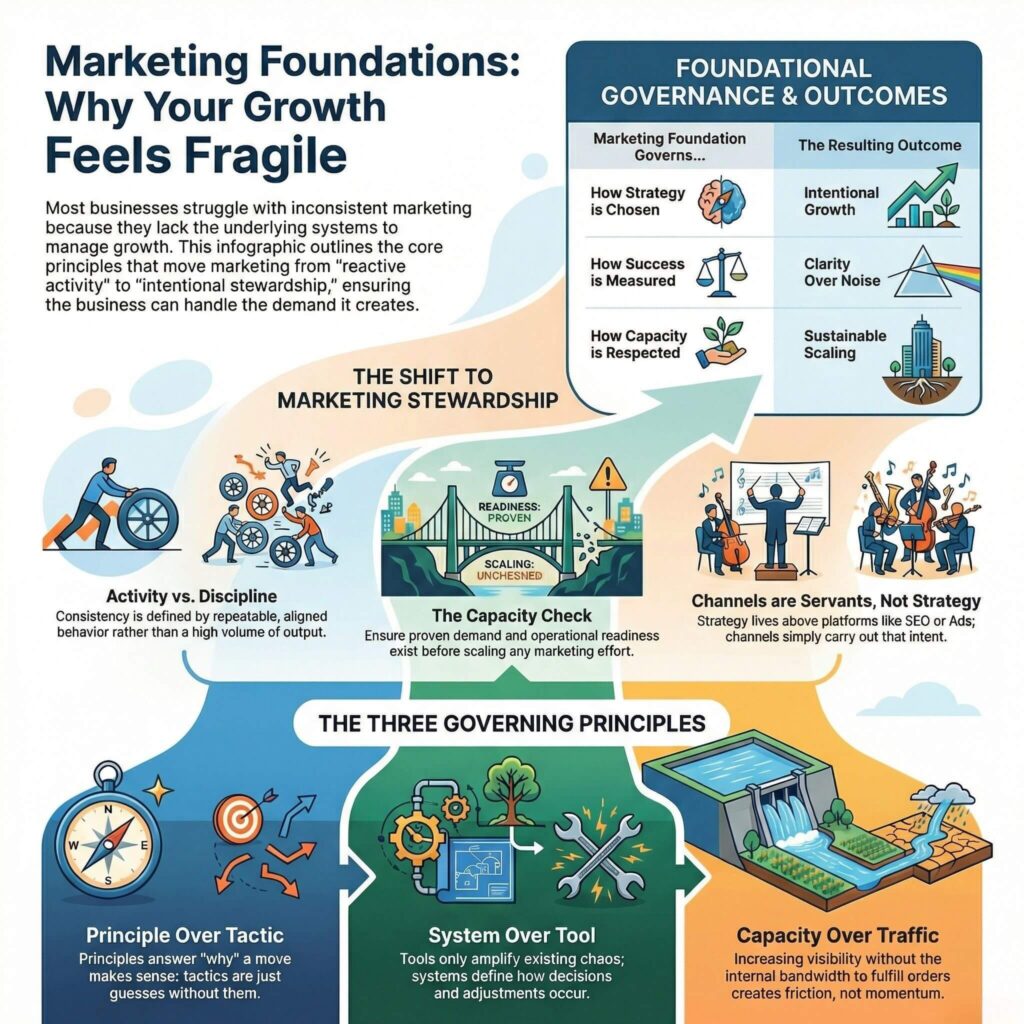
The first principle is this: principle always comes before tactic.
Tactics answer the question what should we do next?
Principles answer the more important question why does this make sense for this business right now?
Without that clarity, tactics become guesses. They may work temporarily, but they decay quickly because they’re not anchored to anything stable. This is why the same strategy can produce wildly different results for two companies in the same industry. One is operating from principle. The other is copying activity.
The second principle is equally foundational: system always comes before tool.
Tools are not strategy. Platforms are not systems. Software does not create alignment.
Tools only amplify what already exists. When there is no governing system — no clear connection between goals, capacity, and accountability — tools simply make the chaos louder. Dashboards fill up. Activity increases. Visibility improves. But clarity does not.
A system, by contrast, defines how decisions are made, how success is measured, and how adjustments occur over time. Tools should support that system, not substitute for it. When tools are chosen before the system exists, marketing becomes dependent on features instead of judgment.
The third principle is the one most often ignored: capacity must come before traffic.
Growth is not neutral. Every new lead, click, or order introduces demand — on your team, your processes, your reputation, and your ability to deliver consistently.
When traffic increases without regard for capacity, growth becomes a liability. Customer experience degrades. Internal stress rises. Quality slips. Marketing may appear to be “working,” but the business quietly absorbs damage it will later have to repair.
This is why more visibility does not automatically mean better outcomes. Traffic without capacity creates friction, not momentum.
These principles are simple, but they are not obvious — especially in an environment that constantly promotes speed, volume, and shortcuts. Most modern marketing advice skips straight to execution and treats fundamentals as optional. They are not.
When principle governs tactic, systems guide tools, and capacity sets the pace for growth, marketing stops feeling reactive. Decisions become calmer. Results become steadier. And progress becomes something the business can actually sustain.
This is where marketing moves from activity to stewardship — and where long-term authority quietly takes root.
A Visual Framework for Marketing Foundations
What Actually Works at This Stage of Marketing Growth
Once foundations are in place, marketing stops being mysterious — not because it’s simple, but because it’s finally being approached with the right mental models.
Experienced operators don’t think about marketing as a collection of activities. They think about it as a system of cause, effect, and feedback.
Every action creates a response.
Every response produces data.
Every signal informs the next decision.
When marketing is treated this way, outcomes stop feeling random. Wins and losses become intelligible instead of emotional. Adjustments are made deliberately, not reactively.
This is why channels are never treated as strategies.
Channels are servants.
They exist to carry intent, not replace it.
Whether it’s paid traffic, organic visibility, or email communication, the channel’s role is execution — not direction. Strategy lives above platforms. When channels are elevated to strategic status, businesses become dependent on mechanics instead of judgment. When they’re kept in their proper place, marketing remains flexible and resilient.
Measurement follows the same logic.
At this stage, metrics are not used for surveillance or justification. They exist to provide clarity.
Good measurement answers questions like:
- Is this moving the business in the direction we intended?
- Is demand increasing faster than capacity?
- Are we learning, or just reporting?
When metrics are disconnected from decision-making, they create noise. When they’re tied to intent, they reduce anxiety. The goal isn’t to track everything — it’s to understand enough to act responsibly.
Consistency is also redefined here.
Consistency is not volume.
It’s discipline.
It’s the willingness to show up repeatedly with aligned effort — not to flood the market with activity. More output does not create stability. Repeatable behavior does. This is why experienced operators value rhythm over bursts and systems over sprints.
None of this relies on shortcuts.
None of it depends on trends.
And none of it requires constant reinvention.
It requires judgment.
Judgment to choose fewer priorities.
Judgment to pace growth appropriately.
Judgment to let systems work before replacing them.
This is what actually works over time: not perfect execution, but principled decision-making applied consistently within a system the business can support.
When marketing is approached this way, complexity is respected without being worshiped. The work remains thoughtful, adaptable, and grounded — and the business gains confidence instead of chaos.
A Necessary Check on Capacity Before Scaling Marketing
Before any marketing system can work reliably, there’s a question that has to be answered honestly:
Can the business support the growth it’s asking for?
At this stage, effective marketing is less about generating demand and more about stewarding it well. The businesses that see the most consistent results aren’t always the ones pushing hardest for more leads — they’re the ones prepared to receive them.
This approach works best for businesses that already have a few fundamentals in place.
There is proven demand for what you offer.
You understand that marketing is an investment, not an experiment.
There is budget discipline — not unlimited spend, but intentional spend.
Your operations can follow through when attention increases.
And you’re willing to pace growth instead of forcing it.
These businesses don’t need marketing to “save” them. They need it to stabilize and compound what’s already working.
On the other hand, there are situations where more marketing — even good marketing — creates pressure instead of progress.
If the business feels overwhelmed before new leads arrive, adding traffic only magnifies that strain.
If ads are expected to “figure it out” without clear direction, outcomes will stay unpredictable.
If the team doesn’t have the bandwidth to fulfill consistently, growth will erode trust instead of building it.
And if the goal is shortcuts rather than systems, results will always be fragile.
None of this is a judgment. It’s simply a reality of scale.
Marketing doesn’t create capacity — it exposes it.
When readiness is present, marketing becomes a force for clarity, momentum, and confidence. When it isn’t, even strong execution can feel destabilizing.
This is why growth-ready businesses don’t rush the process. They ask harder questions up front. They respect the weight of increased demand. And they treat marketing not as a lever to pull impulsively, but as a responsibility to manage carefully.
That mindset protects the business — and it protects the relationship between partner and client. Both sides win when growth is pursued with intention rather than urgency.
A Grounded Perspective on Stewardship and Responsibility in Marketing
At its core, marketing isn’t just a technical discipline. It’s a matter of responsibility.
Every dollar allocated carries weight.
Every promise made shapes expectation.
Every decision affects not just growth, but people.
This is where restraint matters.
A values-driven approach to marketing doesn’t push for speed at the expense of stability. It treats budget as something to steward, not something to burn. It considers the downstream impact of increased demand on teams, customers, and delivery. And it resists the urge to oversell outcomes that haven’t been earned yet.
Discipline becomes the differentiator.
Not discipline as rigidity, but discipline as patience — the willingness to choose clarity over impulse, systems over shortcuts, and long-term trust over short-term wins. This kind of discipline keeps marketing aligned with reality, not aspiration alone.
Integrity shows up here in quiet ways.
In honest timelines.
In realistic expectations.
In saying “not yet” when something isn’t ready to scale.
In aligning growth goals with the ability to serve well.
This posture isn’t about slowing progress. It’s about protecting it.
When marketing is approached with this level of care, it becomes an extension of how the business already operates — measured, thoughtful, and accountable. Growth feels earned rather than forced, and success doesn’t come at the expense of trust.
For organizations that value responsibility alongside results, this isn’t an add-on. It’s the foundation that allows everything else to work.
A Clear Next Step for Marketing Direction and Clarity
If any part of this resonated, the most productive next move isn’t to do more — it’s to see more clearly.
Before scaling effort, it helps to understand what’s actually happening beneath the surface. Where momentum exists. Where friction is forming. And where capacity, systems, or expectations may be misaligned.
That’s what the competitive analysis is designed to provide.
It offers a clear, grounded view of your current marketing landscape — not to overwhelm, but to orient. To identify what’s working, what’s fragile, and what needs to be addressed before growth is pushed further. For many businesses, this clarity alone removes uncertainty and prevents costly missteps.
If you’re not ready for that yet, there’s also space for a simpler conversation.
A clarity call isn’t a pitch. It’s a thinking conversation — a chance to pressure-test assumptions, talk through what you’re seeing, and get unstuck without being sold to. Sometimes direction comes from dialogue, not deliverables.
Both options are designed with the same posture: stewardship over urgency, fit over force, and clarity before commitment.
Choose the step that brings direction, not pressure.