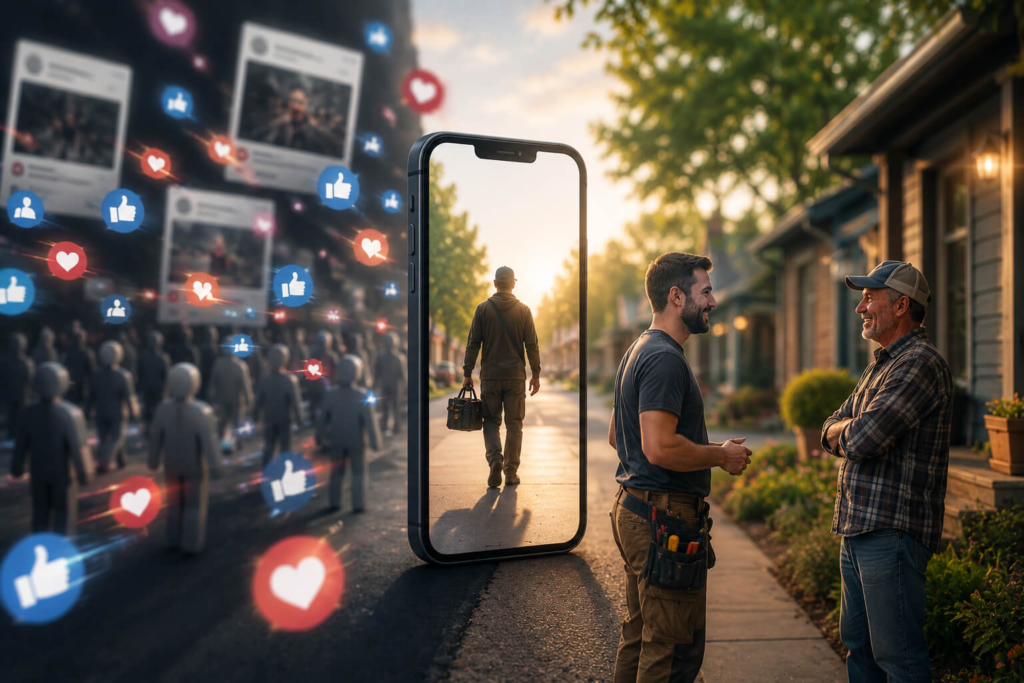
A quick note before we dive in: this article is written for the plumber, roofer, HVAC tech, landscaper, or any local business owner who is trying to figure out why their social media doesn’t seem to turn into actual work. If you have ever posted something and heard nothing but crickets, or wondered if all that effort is worth it, keep reading.
Table of Contents
Let me tell you about three things I saw recently that got me thinking about this.
First, I was scrolling LinkedIn and saw the exact same post five times in a row. Same content, same image, just shared through different business pages and groups. It felt pushy. Honestly, it felt a little desperate. And instead of thinking “hey, I should reach out to this person,” I thought the opposite.
Second, I was at a 1 Million Cups morning gathering, which is one of those early-morning entrepreneur meetups if you have never been. A business owner was explaining their social media strategy, and they were pretty proud of it. They post to their Facebook page and then manually reshare that post into 20-plus Facebook groups. I literally had to bite my tongue.
Third, someone approached me about joining a sharing network. A group where everybody agrees to like and share each other’s posts to make them look more popular. People are still doing this in 2026. I declined.
Here is the thing. I do not think the people doing these things are dumb or dishonest. They are just trying to figure out how to get the word out about their business, and someone told them more exposure equals more customers. It sounds logical. It is not.
So let’s talk about what is actually going on, and what actually works for social media marketing for local businesses.
What Most Businesses Think Works vs What Actually Builds Trust:
| What Feels Like Marketing | What Actually Builds Trust |
|---|---|
| Sharing the same post into 20 groups | Showing real work and results |
| Joining engagement pods | Having real conversations |
| Chasing likes and shares | Helping local people understand something useful |
| Posting generic promotional graphics | Sharing stories and real experiences |
| Looking busy online | Looking trustworthy online |
Does sharing your post to a bunch of groups actually get you customers?
The short answer is no. The longer answer explains why, and it is worth understanding because it changes how you think about all of this.
When you reshare a post to 20 Facebook groups, or when you join a network where people agree to like each other’s stuff, you are chasing something called reach. Reach just means how many people technically saw your content. And reach sounds great. More eyeballs, right?
But here is what you are actually creating: noise. And people are very, very good at tuning out noise.
Think about it from your own experience. When you are scrolling your feed and you see the same thing show up repeatedly, what do you do? You scroll past it faster. You might even feel a little annoyed. Psychologists have a name for this: psychological reactance. It basically means that when people feel like something is being forced on them, they resist it. Not because they decided to, but because that is just how humans work. We protect our own sense of choice.
So the more aggressively you blast your content out, the more you trigger that resistance in people. You do not just fail to win them over. You can actually push them in the other direction.
And that is before we even talk about the platforms themselves, which have gotten very good at detecting this kind of behavior and quietly burying it.
Do the platforms actually know when you are gaming the system?
Yes. And they are getting better at it every year.
Facebook has been openly penalizing what they call “engagement bait” for years now. That means posts that are clearly designed to fish for likes, shares, and comments rather than offer real value. Their algorithm is trained to recognize it, and when it does, it limits how many people see your post. The exact opposite of what you were going for.
LinkedIn went even further in 2026. They published documentation explicitly saying they are working to make engagement pods ineffective, reduce recycled posts, and limit the reach of content that looks like it was boosted through coordinated sharing. They called engagement pods a threat to trust. Those are their words, not mine.
Here is what these platforms care about now: dwell time. That just means how long people actually stop and read your post before scrolling on. A post that gets 200 likes in ten minutes but where nobody actually reads it? The algorithm knows. It can see that people are clicking and immediately bouncing. And it responds by showing your content to fewer people, not more.
On the other hand, a post that makes someone stop and read the whole thing, maybe even type out a real comment, that signals to the platform that your content is worth something. And it rewards you for it.
So those 20 Facebook groups you reshared into? Most of those members are scrolling past your post in about two seconds. And the platform is watching.
So what does actually work for social media marketing for local businesses?
This is where I want to be really direct with you, because there is a lot of bad advice out there and a lot of it costs local business owners time and money they do not have.
What works is trust. And trust is slow. There is no shortcut to it, which is exactly why so many people keep chasing the shortcuts instead.
Here is the most important reframe I can offer you: stop thinking about social media as a megaphone and start thinking about it as a way to have conversations in public. Every post you make, every comment you leave, every time you show up online, you are either adding to your reputation or taking away from it. There is no neutral.
The businesses that win on social media are the ones that show up consistently, say something real, and make the people reading feel like they are getting something useful. Not because they ran a sophisticated marketing campaign, but because they acted like a person instead of a billboard.
That sounds simple. It is harder than it sounds. But it is also more durable than anything the engagement pods can produce.
What does “building trust” actually look like in practice?
I know “build trust” can sound like vague marketing speak. So let me make it concrete.
Show the real work. If you are a plumber, take a photo of the before and after on a job. If you are a roofer, show the storm damage and then show what it looks like fixed. People who are searching for someone to hire want to see evidence that you are good at what you do. Not a logo. Not a generic “family-owned since 1987” post. The actual work.
Talk like a person. The posts that get real engagement, the kind where people actually stop and comment, are almost never the polished professional ones. They are the ones where somebody sounds like themselves. A story about a weird job. Something that went sideways and how you handled it. An honest opinion about something in your industry. People connect with people, not brands.
Answer the questions your customers are already asking. What does it cost to replace a water heater? How do I know if my AC is dying or just needs a tune-up? How long does a roof usually last in this climate? You know the answers to these questions. Your potential customers are typing them into Google. Write the answer down. Post it. You become the expert before they ever call you.
Engage with other people’s stuff, genuinely. One real comment on a neighboring business’s post, or on a customer’s post, does more for your visibility and reputation than ten reshares of your own content into random groups. LinkedIn’s own research shows that a thoughtful comment carries fifteen times the weight of a like in their algorithm. Leave comments that actually add something, not just “great post!” That is engagement bait in reverse and it does not work either.
Ask for reviews in the right moments. The best time to ask a customer for a review is right after a job goes well, when they are still happy. Not a week later in a generic email blast. Right then. “Hey, if you have a minute, an honest review on Google would really help us out.” That one sentence, said at the right moment, is worth more than a hundred reshares.
What Better Social Media Looks Like for Local Businesses:
| Instead of This… | Try This Instead |
|---|---|
| Generic “Call us today!” posts | Show a real project you finished this week |
| Polished stock graphics | Photos from real jobs |
| Talking like a company | Talking like a real person |
| Posting only promotions | Answering customer questions |
| Sharing into random groups | Engaging with people in your community |
| Chasing viral reach | Building local trust |
What about those sharing networks and pods? Are they ever worth it?
There is a difference between manufactured engagement and genuine community support, and it matters.
If you do good work and you have real relationships with other business owners in your area, it is completely fine to reach out and say “hey, I posted something you might find useful, feel free to share it if it resonates.” That is normal. That is how referrals have worked forever, just online.
What does not work, and what platforms are actively cracking down on, is the formalized “you like mine and I will like yours” systems. The sharing networks where everyone agrees to engage with each other’s content regardless of whether it is actually good or relevant. These systems feel like a shortcut, but they are actually a trap.
Here is why. When your content gets artificial engagement from people who are not your customers and never will be, two bad things happen. First, the platform figures it out and limits your reach. Second, and this is the more important one: you lose the ability to tell what is actually working. Your numbers look okay. But you are not getting calls. You do not know why. You keep doing the same thing. The feedback loop is broken.
When you build your engagement honestly, even if the numbers are smaller, you can actually read them. Fifteen real people in your service area seeing your post and one of them calling you is worth infinitely more than five hundred pod members clicking like and moving on.
What about the fear of posting something and getting zero response?
This is real, and I want to name it because it keeps a lot of good business owners from posting anything at all.
There is something uncomfortable about putting something out there and having nobody respond. In a professional context, it can feel like public failure. So people either do not post at all, or they join a pod so they can at least guarantee a few likes and feel like they are not standing in an empty room.
I get it. But here is the thing: a post with three genuine likes from people in your actual market is more valuable than a post with fifty likes from a sharing network. The three people who actually stopped and engaged? They are real. The algorithm can tell the difference, and so can anyone who visits your profile.
If you are worried about silence, the better solution is to start smaller and more personal. Post about something specific that happened this week. Ask a genuine question you actually want people’s opinions on. Reach out directly to five or ten people you actually know and ask what they think of it. Build it slow and build it real.
The goal is not to look popular. The goal is to look trustworthy. Those are not the same thing.
How do I know if my social media is actually working?
This is a question most local business owners never ask, and they should ask it first.
Forget about likes, impressions, and followers for a second. Ask yourself these questions instead:
Did anyone who saw my content reach out to me this month? Did a new customer mention they found me online? When someone searches my business name, does what comes up make me look credible or does it look abandoned? Am I getting more Google reviews from real customers than I was six months ago?
Those are the signals that matter for a local service business. Not your follower count. Not how many groups you shared something to. Whether real people in your market, the kind who might actually hire you, are seeing you, believing you, and reaching out.
If the answer is no, the solution is not to blast your content harder. The solution is to say something more real, more useful, and more specific to the people you actually want to reach.
The bottom line on social media marketing for local businesses
Here is the simplest way I can say it.
You can manufacture activity. You cannot manufacture trust. And in local business, trust is everything. It is the reason people call you instead of the guy they found on a flyer. It is why they refer you to their neighbor. It is what turns a one-time job into a customer relationship that lasts years.
Social media can build that trust, but only if you use it to actually show up as yourself, do good work publicly, and have real conversations with real people. The engagement pods, the resharing networks, the 20-group Facebook blasts, all of those things might look like marketing. They are not. They are noise that erodes the very thing you are trying to build.
The slow way is the right way. It always has been.
Coast333 works with local service businesses to build marketing that generates real outcomes, not vanity metrics. If you want to talk about what that looks like for your business, we are easy to reach.