
Table of Contents
Why Marketing Budget Matters in HVAC
Many HVAC companies assume their marketing problems are caused by choosing the wrong channel. Owners often ask whether they should be investing in Google Ads, Local Services Ads, SEO, social media, or direct mail. While channel selection matters, it is rarely the primary reason a company struggles to generate consistent demand.
In reality, most HVAC companies do not fail at marketing because they choose the wrong channel. They struggle because they underinvest in marketing or invest inconsistently. Campaigns start and stop, budgets fluctuate based on short-term results, and marketing is often treated as a reactive expense rather than a structured growth system.
The most successful HVAC companies approach marketing differently. Instead of guessing how much to spend, they align their marketing investment with their growth goals. Marketing becomes a strategic decision tied directly to the amount of demand the company needs to generate in order to grow.
Industry benchmarking research consistently supports this approach. One of the most widely cited budgeting frameworks in the HVAC industry suggests that marketing investment should scale based on the company’s growth ambition:
- Approximately 5% of annual revenue to maintain current performance
- Roughly 8–10% of revenue to support steady growth
- Around 12–14% of revenue for aggressive expansion and market share gains
HVAC Marketing Budget Benchmark…
This framework is often referred to as an HVAC marketing budget benchmark, because it helps owners understand how much investment is typically required to produce different levels of growth.
Understanding these benchmarks is critical because marketing demand must be purchased, created, or amplified. If a company wants to increase revenue, it must generate more service calls, replacement opportunities, and customer relationships. Marketing investment is the mechanism that makes that growth possible.
This guide explains what HVAC companies actually spend on marketing, how those investments typically scale with revenue, and how to determine the right marketing budget for your company’s growth goals.
How Much HVAC Companies Typically Spend on Marketing
While many HVAC owners debate how much they should spend on marketing, industry survey data reveals what contractors are actually doing in the real world.
Research from the ACCA Contractor of the Future study indicates that the average HVAC contractor spends roughly 6% of annual revenue on marketing and advertising.
HVAC Marketing Budget Benchmark…
This figure represents a useful baseline because it reflects the behavior of thousands of contractors across the industry. In other words, a company spending around six percent of revenue on marketing is operating near the industry average.
However, the same research highlights an important distinction. Contractors investing 12% or more of revenue into marketing were significantly more likely to report higher profit performance compared with those investing at lower levels.
HVAC Marketing Budget Benchmark…
This does not necessarily mean that simply increasing marketing spend automatically increases profitability. Instead, higher marketing investment tends to correlate with companies that have developed more mature business systems.
Companies investing heavily in marketing are often also investing in the operational capabilities required to convert demand into revenue. These organizations typically have stronger internal systems, including:
- More structured marketing and reporting processes
- More reliable call answering and booking procedures
- Stronger pricing and sales discipline
- More operational maturity across dispatch, sales, and customer experience
In other words, marketing investment tends to work best when it is supported by a company that is operationally prepared to handle increased demand. For growth-stage HVAC companies, the goal is not simply to spend more on marketing, but to build the systems required to turn marketing investment into predictable revenue growth.
HVAC Marketing Budget Benchmarks by Revenue
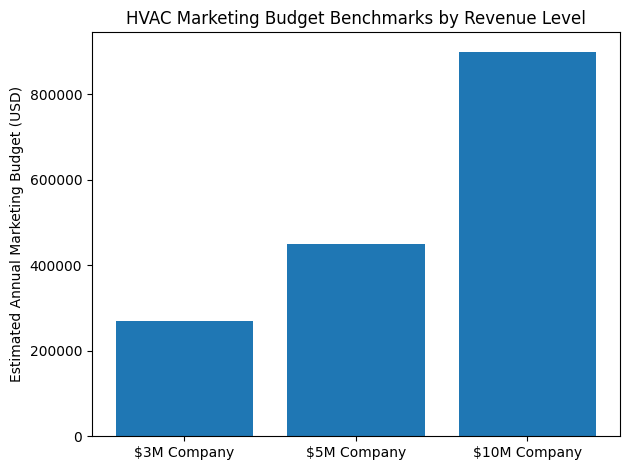
While percentage-based marketing benchmarks are helpful, most HVAC owners find it easier to understand marketing investment when it is translated into real dollar amounts tied to company revenue.
The following table converts commonly cited HVAC marketing benchmarks into estimated annual marketing budgets across different revenue levels.
HVAC Marketing Budget Benchmarks
| Annual Revenue | Maintain (~5%) | Growth (~8–10%) | Aggressive (~12–14%) |
| $1M | $50k | $80k–$100k | $120k–$140k |
| $3M | $150k | $240k–$300k | $360k–$420k |
| $5M | $250k | $400k–$500k | $600k–$700k |
| $10M | $500k | $800k–$1M | $1.2M–$1.4M |
| $20M | $1M | $1.6M–$2M | $2.4M–$2.8M |
These ranges represent one of the most practical HVAC marketing budget benchmarks available to contractors because they directly connect three critical factors:
Revenue → Growth Goal → Marketing Investment
In other words, marketing budgets should not be set randomly or based solely on what a company spent the previous year. Instead, they should be determined by the level of growth the business wants to achieve.
Industry research consistently frames these ranges as growth-planning guidelines rather than rigid rules. Companies aiming to maintain their current revenue levels typically invest around five percent of revenue into marketing. Businesses targeting moderate growth generally move closer to the eight to ten percent range, while companies pursuing aggressive expansion often invest twelve percent or more.
HVAC Marketing Budget Benchmark…
For HVAC companies in the $1M–$20M range, this type of structured budgeting helps translate growth ambition into a clear marketing investment strategy.
If you want to estimate your own marketing investment based on revenue and growth targets, you can use our HVAC Marketing Budget Planner to model different budget scenarios and see how marketing investment scales with company growth.
Cost Per Lead Benchmarks HVAC Owners Should Know
Understanding marketing budgets is only part of the equation. HVAC owners also need to understand acquisition economics—specifically how much it typically costs to generate new leads and customers through different marketing channels.
Across large datasets in the HVAC and home services industry, several consistent benchmarks have emerged for paid digital advertising.
For Google Ads, one of the most widely used lead generation channels for HVAC contractors, industry datasets show the following averages:
- Average cost per lead (CPL): approximately $104
- Non-branded search CPL: around $149
- Cost per paying customer: roughly $804
HVAC Marketing Budget Benchmark…
These numbers represent blended averages across hundreds of contractors and multiple campaign types, including branded searches, non-branded searches, and automated campaign formats.
Local Services Ads (LSAs), another major demand channel for HVAC companies, often produce leads at somewhat lower costs. Across multiple home-services benchmarks, LSA leads frequently fall within the $50–$90 range, though actual costs can vary significantly depending on market competition and demand.
Third-party lead marketplaces—such as Angi or HomeAdvisor—typically operate on a pay-per-lead model. Reported ranges for these platforms often fall between $15 and $100 per lead, depending on the category and geographic market.
HVAC Marketing Budget Benchmark…
However, focusing only on cost per lead can be misleading. In HVAC marketing, the more important metric is cost per booked job. A lower-cost lead may appear attractive, but if it does not convert into a scheduled service call or installation opportunity, it ultimately produces little value. Focus on quality leads.
Because HVAC businesses are service-driven and appointment-based, the real economic performance of marketing depends on the full conversion process: lead generation, call handling, booking rate, technician performance, and sales conversion. Strong operators track all of these steps to understand the true cost of acquiring new customers.
If you’re trying to understand what HVAC leads actually cost, we’ve compiled real-world HVAC cost per lead benchmarks across Google Ads, Local Services Ads, and SEO. See what contractors typically pay and how to evaluate whether your lead costs are profitable.
How HVAC Marketing Budgets Are Typically Allocated
Once HVAC companies determine how much they should invest in marketing, the next question becomes how that budget should be distributed across different channels and activities.
Industry guidance commonly references a 10% growth-budget framework, which divides marketing investment between media spend and the operational resources required to support it. In this model, roughly 80% of the marketing budget is allocated to media, while the remaining 20% supports strategy, production, and operational execution.
HVAC Marketing Budget Benchmark…
Within the media portion of the budget, spending is often distributed across several major categories:
- Digital marketing: approximately 35%
- Direct mail: roughly 25%
- Traditional brand marketing: around 20%
HVAC Marketing Budget Benchmark…
Digital marketing typically includes channels such as Google Ads, Local Services Ads, search engine optimization, and online reputation management. Direct mail may include targeted mailers, seasonal promotions, or service agreement campaigns. Traditional brand marketing can include radio, local television, sponsorships, or community advertising.
While these allocations vary from company to company, one trend has become increasingly clear across the HVAC industry: digital channels now drive the majority of measurable demand. Search engines, map listings, and online reviews often determine whether homeowners discover and contact a contractor in the first place.
As a result, many growth-stage HVAC companies allocate an increasing share of their marketing investment toward digital demand-generation channels while still maintaining a diversified marketing mix.
The Hidden Marketing Costs Most HVAC Owners Ignore
One of the most important insights from industry research is that marketing performance is not determined by advertising alone. Operational systems within the company have a direct impact on whether marketing investment actually produces revenue.
Several operational factors significantly influence both marketing visibility and lead performance. These include:
- The number and quality of customer reviews
- How quickly the company responds to incoming leads or calls
- The effectiveness of call handling and booking processes
- The efficiency of dispatch and scheduling systems
Search platforms increasingly factor these operational signals into how businesses appear in local results. Google’s local ranking guidance explicitly notes that reviews and ratings contribute to a business’s prominence in local search visibility, meaning companies with stronger reputations are more likely to appear when homeowners search for services.
HVAC Marketing Budget Benchmark…
Consumer behavior research reinforces the importance of reputation. Studies show that 68% of consumers will only consider businesses with at least a 4-star rating, and 31% require ratings of 4.5 stars or higher before choosing a company.
HVAC Marketing Budget Benchmark…
Because of this, many of the most important marketing investments do not appear in traditional advertising budgets. HVAC companies often need to allocate resources toward systems that improve both visibility and conversion, including:
- Review generation and reputation management systems
- Call center capacity and after-hours answering
- Customer relationship management (CRM) software and automation
When these systems are implemented effectively, they strengthen both marketing performance and operational efficiency. The result is a marketing engine that not only generates leads, but also converts those leads into booked work and long-term customer relationships.
Growth-stage HVAC companies often plan marketing investment based on the revenue targets they want to achieve rather than current revenue. If you’re evaluating different growth scenarios, our HVAC Revenue Forecast Calculator can help estimate what those targets might look like over time.
How $10M HVAC Companies Think About Marketing
One of the clearest differences between smaller HVAC companies and larger operators is how they approach marketing. As companies scale into the $10M revenue range and beyond, marketing is no longer treated as a collection of isolated tactics. Instead, it becomes part of a structured growth system designed to generate predictable demand.
Research consistently shows that larger contractors tend to differentiate themselves through several key characteristics. These companies typically invest in structured marketing systems, adopt professional operational software, and maintain consistent marketing investment over time rather than adjusting budgets unpredictably based on short-term results.
For example, industry research indicates that 83% of larger contractors (those operating ten or more vehicles) use field service management software, compared to only 31% of smaller contractors with fewer than five vehicles.
HVAC Marketing Budget Benchmark…
This difference is important because marketing performance is closely tied to operational infrastructure. Field service management platforms allow companies to track lead sources, monitor booking rates, measure technician performance, and understand which marketing channels are generating the most profitable work.
Larger HVAC companies also tend to approach marketing budgets more strategically. Instead of deciding how much to spend based on what feels comfortable, they often work backward from revenue targets, using HVAC marketing budget benchmarks to determine how much demand generation investment is required to support their growth goals.
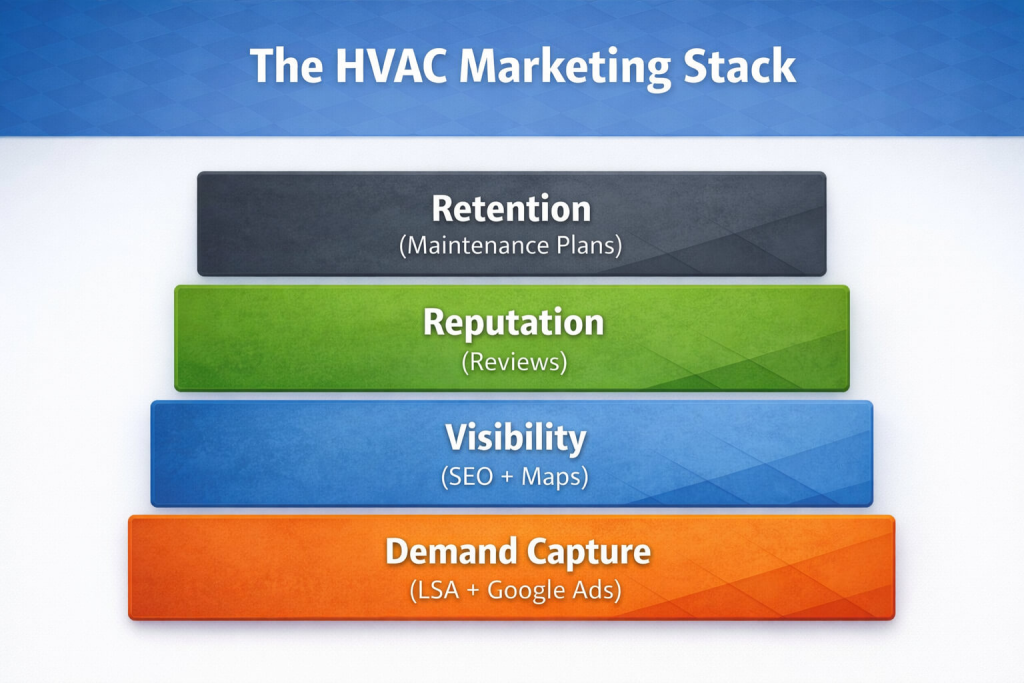
In other words, these companies treat marketing as a system, not a tactic. Marketing, operations, sales, and customer experience all work together to generate, capture, and convert demand at scale.
Marketing Investment Is a Growth Decision
The HVAC industry is becoming more competitive every year. Private equity consolidation is increasing across many markets, digital advertising costs continue to rise, and homeowners increasingly rely on online search, reviews, and reputation signals when choosing a contractor.
In this environment, marketing can no longer be treated as an afterthought or a reactive expense.
Companies that approach marketing casually often experience unpredictable demand. Busy seasons are followed by slow periods, and revenue growth becomes difficult to sustain because lead flow depends too heavily on referrals or seasonal fluctuations.
By contrast, companies that treat marketing as a structured investment gain a powerful strategic advantage. They build systems that consistently place their business in front of homeowners when heating or cooling problems arise.
These companies appear where customers search. They convert more inquiries into booked service calls. And they generate installation opportunities that drive long-term revenue growth.
For growth-oriented HVAC contractors, marketing investment is not simply a cost. It is one of the most important decisions that determines whether a company remains stagnant or builds a business capable of growing year after year.