
Table of Contents
Why HVAC Cost Per Lead Matters
One of the most common questions HVAC owners ask when evaluating their marketing is simple: What should a lead cost? When advertising costs rise or lead prices fluctuate, many contractors assume something is wrong with their marketing strategy. In reality, the situation is often more complicated. Cost per lead can vary significantly depending on the marketing channel being used, the competitiveness of the local market, and the type of demand being captured.
Part of the confusion comes from the fact that the term “lead” is not always defined consistently. In some cases, a lead may represent a tracked phone call from a homeowner searching for HVAC services. In other situations, it may be an online form submission, a booked appointment through a scheduling tool, or even a pay-per-lead contact from a marketplace platform. Because these interactions are measured differently across marketing platforms, the reported cost per lead can vary widely even when the underlying marketing performance is healthy.
For growing HVAC companies, the real objective is not simply to lower cost per lead as much as possible. Instead, the goal is to acquire profitable customers in a predictable and sustainable way. A slightly higher lead cost can still produce excellent results if the leads convert into booked appointments and high-value jobs.
This guide explores what realistic HVAC cost-per-lead benchmarks look like across different marketing channels, why those costs vary from market to market, and how contractors should evaluate whether their marketing investment is producing profitable growth.
Why HVAC Leads Are Expensive
Before looking at specific benchmarks, it’s important to understand why HVAC leads often cost more than leads in many other local service industries. The answer largely comes down to the economics of the HVAC market and the type of demand contractors are competing to capture.
One of the biggest drivers of HVAC lead costs is high-intent emergency demand. Homeowners rarely search for heating or cooling services casually. In many cases, the search happens because something has gone wrong: an air conditioner fails during extreme summer heat, a furnace stops working in the winter, or a homeowner realizes their aging system needs to be replaced. These urgent situations create strong purchase intent, and contractors know that homeowners searching for these services are often ready to book quickly. As a result, many companies compete aggressively to appear in front of those searches.
Another factor is the way modern advertising platforms operate. Systems like Google Ads run on a competitive auction model. Contractors bid against each other to appear for searches such as “AC repair near me” or “furnace replacement.” When multiple companies target the same high-value keywords, advertising costs rise. HVAC is widely considered one of the most competitive categories in the home services sector, which naturally pushes acquisition costs higher.
Finally, HVAC companies can justify higher lead costs because the value of a new customer is substantial. Industry benchmarks place the average HVAC service ticket at roughly $390 to $422, while full system replacements commonly generate $7,500 or more in revenue depending on equipment and market conditions. Because a single installation job can produce thousands of dollars in revenue, many contractors are willing to invest more aggressively in marketing to secure those opportunities.
Taken together, these economic realities explain why HVAC cost-per-lead benchmarks tend to be higher than in many other local industries. High-value jobs, urgent homeowner demand, and competitive advertising markets all contribute to the elevated cost of acquiring new HVAC customers.
If you want to estimate your own marketing investment based on revenue and growth targets, you can use our HVAC Marketing Budget Planner to model different budget scenarios and see how marketing investment scales with company growth.
HVAC Cost Per Lead Benchmarks by Marketing Channel
Cost per lead can vary significantly depending on the marketing channel used. Different platforms attract homeowners at different stages of the buying process, which affects both the cost of acquiring the lead and the likelihood that the lead will convert into a paying customer.
The benchmarks below are based on large datasets from HVAC and home services advertising campaigns and provide a realistic view of what contractors may experience across common digital marketing channels.
HVAC Cost Per Lead Benchmarks
| Channel | Typical CPL |
| Google Ads (blended) | ~$104 |
| Google Ads (non-brand) | ~$149 |
| Google Ads (branded) | ~$34 |
| Google Performance Max | ~$72 |
| Local Services Ads | ~$51 |
| SEO / organic (allocated) | ~$69 |
| Third-party lead platforms | ~$15–$100 |
These numbers illustrate an important point: not all leads are created equal. Each marketing channel captures demand in a slightly different way.
For example, Google Ads non-brand searches often capture homeowners actively searching for immediate solutions, such as “AC repair near me” or “furnace replacement.” These leads can be highly valuable, but they also tend to be more expensive because many contractors compete for the same searches.
Local Services Ads (LSAs) frequently generate leads from homeowners comparing multiple contractors within Google’s local service marketplace. These leads can be less expensive than search ads but may also involve more competition between contractors responding to the same request.
Meanwhile, organic search results and Google Maps visibility often generate leads from homeowners who already recognize a company’s brand or reputation. Because these channels rely on long-term visibility and trust signals like reviews, the cost per lead is typically calculated as an allocated cost based on SEO investment rather than a direct advertising price.
For this reason, evaluating HVAC marketing performance requires more than simply comparing cost per lead across channels. Understanding lead quality, conversion rates, and job value is just as important when determining whether a marketing strategy is producing profitable growth.
Why HVAC Cost Per Lead Varies So Much
Many contractors compare their cost-per-lead numbers to other companies and assume something is wrong when the numbers do not match. In reality, HVAC lead costs can vary widely even when marketing campaigns are performing well. Several factors influence how much contractors ultimately pay to acquire new leads.
One of the biggest drivers of cost variation is market competition. Contractors operating in large metropolitan areas often face significantly higher advertising competition than those in smaller cities or rural markets. When more companies bid on the same keywords or compete for visibility in the same service area, advertising platforms raise prices through auction dynamics. Benchmark datasets illustrate this clearly. Some smaller markets report Local Services Ads leads as low as around $30, while highly competitive metro areas can exceed $90 or more per lead.
Another important factor is the type of service being marketed. Not all HVAC searches carry the same level of urgency or competition. For example, searches related to routine maintenance or seasonal tune-ups typically attract less competition than high-intent emergency queries. Searches such as AC repair, emergency HVAC service, or furnace replacement often generate the most competitive bidding environments. In some cases, service-specific campaigns targeting these urgent needs can produce cost-per-lead values exceeding $200 or more, particularly in competitive markets.
Reputation and visibility also play a major role in lead costs. Google’s local search rankings are influenced by factors including relevance, distance, and prominence. Businesses with strong review profiles, consistent ratings, and well-optimized Google Business Profiles tend to appear more prominently in local results. Higher visibility often leads to more organic calls and clicks, which can reduce the effective cost of acquiring new leads.
Finally, operational performance inside the company can influence marketing results. Response speed, call handling, and scheduling processes all affect how efficiently leads convert into booked appointments. If calls are missed or homeowners experience long wait times before speaking with someone, marketing dollars are effectively wasted. Even small improvements in response time and booking efficiency can significantly improve overall marketing ROI and reduce the effective cost of acquiring customers.
Growth-stage HVAC companies often plan marketing investment based on the revenue targets they want to achieve rather than current revenue. If you’re evaluating different growth scenarios, our HVAC Revenue Forecast Calculator can help estimate what those targets might look like over time.
Cost Per Lead vs Cost Per Booked Job
Cost per lead is only the first step in understanding marketing performance. While CPL is often the number contractors focus on first, it does not fully explain whether marketing is actually producing profitable work. The metric that often matters more in real operations is cost per booked appointment.
Every marketing lead must move through several stages before it becomes revenue. A homeowner clicks an ad or finds a business in search results, makes contact, and then decides whether to schedule service. If that scheduling step does not happen consistently, even relatively inexpensive leads can become costly.
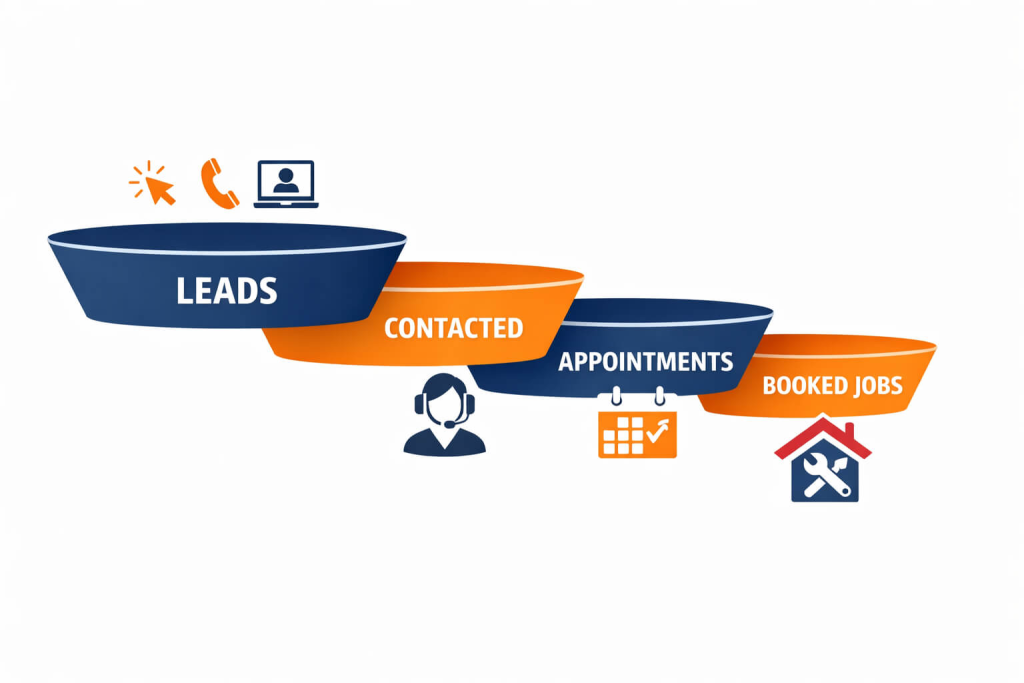
For example, consider a company paying an average of $120 per lead. If that company successfully books appointments for 40% of incoming leads, the real cost of generating a booked job increases significantly.
Example:
Lead cost: $120
Booking rate: 40%
Cost per booked job: $300
This illustrates why two HVAC companies paying the exact same cost per lead may experience very different results. One company may book half of its leads and keep acquisition costs relatively low, while another may struggle to convert inquiries into appointments.
Cost per lead is only part of the equation, and understanding what it actually costs to acquire a customer is what determines profitability, which we break down in HVAC Customer Acquisition Cost Explained.
Improving call handling, response speed, and booking processes can dramatically increase marketing performance without increasing advertising spend. For many HVAC companies, operational improvements in these areas produce some of the fastest gains in marketing return on investment.
Cost Per Customer Economics
While cost per lead is useful for understanding advertising performance, the most meaningful metric for HVAC marketing is cost per paying customer. This metric reflects the full path from marketing contact to completed job and provides a clearer view of whether marketing investments are profitable.
Large benchmark datasets from HVAC and home services advertising campaigns illustrate how these economics typically work. For example, research tracking thousands of HVAC advertising leads found that Google Ads campaigns generated an average cost of approximately $472 per paying customer when measured across all campaign types. When focusing specifically on non-brand acquisition campaigns—where contractors compete for new customers rather than brand searches—the average cost per customer increased to roughly $804. In comparison, Local Services Ads produced an average cost of about $233 per customer in the same dataset.
At first glance, these numbers may seem high. However, they need to be evaluated within the broader economics of HVAC services.
Consider a simple example. If an installation job generates $8,000 in revenue, and the marketing investment required to acquire that customer is $800, the marketing cost represents roughly 10 percent of the total revenue from that job. For many HVAC businesses, this level of customer acquisition cost is both manageable and sustainable, especially when replacement systems, maintenance plans, and future service opportunities are considered.
This is why experienced HVAC operators evaluate marketing performance using customer acquisition cost and lifetime customer value, rather than focusing exclusively on the cost of individual leads. When viewed in the context of job value and long-term customer relationships, higher lead costs can still support strong business growth.
For contractors trying to determine how much they should invest in advertising, understanding both cost per lead and total marketing investment is important. Our guide to HVAC marketing budget benchmarks explains how growing contractors typically allocate marketing spend and how those budgets relate to lead generation performance.
Why Cheap Leads Are Often the Worst Leads
Many contractors naturally focus on finding the lowest possible cost per lead. On the surface, this approach seems logical. If leads are cheaper, it should mean marketing is more efficient. In practice, however, the lowest-cost leads often produce the weakest results.
One reason is that many inexpensive leads come from shared lead marketplaces. Platforms that sell leads to multiple contractors at the same time may appear inexpensive on a per-lead basis, but the homeowner is often contacted by several companies simultaneously. This creates a highly competitive situation where contractors must compete on price or speed rather than service quality.
Many contractors discover that cheaper leads often come from shared marketplaces or price-shopping customers. As discussed in our article on HVAC lead quality, the real goal of marketing is generating profitable customers rather than simply lowering cost per lead.
Another issue is that low-cost leads frequently attract price-shopping customers. These homeowners may be looking for the lowest bid rather than the most qualified contractor. As a result, the likelihood of booking the job or maintaining healthy margins can drop significantly.
Cheap leads can also originate from low-intent search traffic, where homeowners are researching options rather than actively scheduling service. These leads may inflate lead counts without producing meaningful revenue.
For this reason, experienced HVAC companies evaluate marketing performance based on lead quality and profitability, not simply the lowest cost per lead. Higher-quality lead sources—such as high-intent search traffic, strong local visibility, and trusted brand reputation—often cost more upfront but produce better booking rates, higher-value jobs, and more sustainable growth.
Simple comparison chart:
| Lead Source | Typical CPL | Lead Quality | Competition |
|---|---|---|---|
| Google Ads | $$$ | High | Medium |
| Local Services Ads | $$ | High | High |
| Organic SEO | $ | Very High | Low |
| Lead Marketplaces | $ | Low | Very High |
What Good HVAC Marketing Performance Looks Like
For most residential HVAC contractors, realistic cost-per-lead expectations typically fall within a few broad ranges depending on the marketing channel being used. Based on available benchmark data, Local Services Ads often generate leads in the range of $50 to $90 per lead, while Google Ads acquisition campaigns commonly produce leads between $100 and $200. Organic search leads driven through SEO efforts are usually calculated differently, but many studies estimate an allocated cost of roughly $69 or more per lead once marketing investment and internal effort are factored in.
These numbers should not be viewed as rigid rules. In practice, HVAC lead costs vary widely depending on several important factors. Market competition plays a major role, as contractors operating in large metropolitan areas often face significantly higher advertising costs than those in smaller markets. Service area density also matters, since regions with more HVAC companies competing for the same customers tend to drive up advertising prices.
A company’s brand reputation can influence lead costs as well. Contractors with strong review profiles, recognizable brands, and consistent customer experience often generate more organic demand and higher conversion rates. Finally, marketing execution itself plays a major role. Campaign structure, keyword targeting, landing page quality, and call handling processes can all impact how efficiently leads are generated and converted.
Because of these variables, successful HVAC companies rarely judge marketing performance based on a single cost-per-lead number. Instead, they evaluate marketing through the lens of profitability, conversion performance, and long-term demand generation. A slightly higher lead cost can still represent strong marketing performance if those leads convert into booked appointments, high-value jobs, and repeat customers.
Understanding HVAC Lead Economics
HVAC marketing performance cannot be measured by cost per lead alone. While CPL is often the most visible number in marketing reports, it represents only the first step in a much larger demand system.
The most successful HVAC companies evaluate marketing performance across several key metrics, including cost per lead, booking rate, customer acquisition cost, and job revenue. Looking at these numbers together provides a far more accurate picture of how effectively marketing is driving business growth.
For example, two contractors may pay the same cost per lead, yet achieve very different results depending on how efficiently they convert those leads into booked appointments and completed jobs. Companies with strong call handling, scheduling processes, and service delivery often generate significantly more revenue from the same marketing investment.
Cost per lead is only one part of a much larger demand system. Contractors who want a deeper understanding of how digital marketing, reviews, advertising, and search visibility work together can read our complete guide to HVAC marketing.
Contractors who understand these economics are able to invest in marketing with greater confidence. Instead of chasing the lowest possible lead cost, they focus on building systems that consistently produce profitable customers.
In an increasingly competitive HVAC market, this broader understanding of acquisition costs and conversion performance is essential. Companies that approach marketing as a structured demand engine are far more likely to achieve predictable growth than those that rely solely on finding the cheapest leads.