
Free Competitive Marketing Analysis
Find out who’s actually winning your customers.
Name three competitors. We’ll work through how each one is winning online — how they earn visibility, what they advertise, and how they turn visitors into customers, whether that means a phone call, a booked job or an online order — then sort the findings by what actually deserves your attention first. Free, and the findings are yours to keep.
The blind spot
The competitors you’d name aren’t always the ones you’re up against.
Most owners picture their competitors as the businesses they recognise by name. Online, the ones competing for the same searches, clicks and customers are often somebody else entirely — bigger brands, marketplaces, directories, or businesses you’ve never thought of as competition at all.
What you picture
The businesses you know
The names you’d list if someone asked who you compete with.
- The business across town
- The best-known name in your category
- The one you lost your last big customer to
What’s actually there
Everyone competing for the same click
The highlighted ones rarely show up on anybody’s list.
- The business across town
- The best-known name in your category
- The one you lost your last big customer to
- Larger regional and national brands
- Marketplaces, directories and aggregators
- Businesses buying the searches you want
- Sites outranking you organically
- Anyone else your customer considers before you
Those categories compete for the same searches, the same ad placements and the same customers you do. Most businesses have never looked at them, which is part of why they keep winning. We work from publicly observable signals and third-party estimates — not private competitor data, which nobody outside those companies has.
What we look at
One framework, weighted to how you win customers.
Each of the three businesses is compared across the same six areas, so the findings are comparable rather than anecdotal. What changes is the emphasis. A local service company, an online store and a national brand win customers in different places, and the analysis follows where your customers actually decide.
Search visibility
Where they appear in organic and paid search — and, where it matters, in Maps or in Shopping and product results — across the market you actually compete in.
Paid advertising activity
Which paid channels they appear to be using, what they’re promoting, and where they’re competing for the same demand you want.
Conversion path
How traffic becomes business: landing and product pages, offers, and the path to a call, form, booking or completed checkout.
Authority & content
Who’s building durable visibility through structured content, technical SEO and trust signals.
Opportunity gaps
Where they’re weak, absent or ignoring demand — the openings actually worth going after.
Acquisition efficiency
From public signals, estimated costs and category economics: where budget in your market tends to get wasted, and where cheaper demand sits unclaimed. Not their private accounts or results.
What comes back
A list of problems isn’t a plan. The order is.
Any tool can produce forty-seven issues. What makes an analysis useful is knowing which one to act on first — and which ones to leave alone for now. Here’s what the underlying research actually looks like, and how the findings come back sorted.
One example, from a local service business — anonymised from a real Coast333 analysis
One local service business against the three competitors its owner named.
| Keywords on page 1 |
Total ranking keywords |
Est. monthly organic visits |
Domain authority |
|
|---|---|---|---|---|
| Your Business | 2 | 20 | 9 | 7 |
| Competitor A | 99 | 4,900 | 601 | 16 |
| Competitor B | 43 | 116 | 1,400 | 21 |
| Competitor C | 60 | 663 | 655 | 20 |
Real figures from a completed analysis, with the business and competitor identities removed. Organic visit counts and domain authority are third-party estimates, not measured traffic — they’re useful for comparison between sites, not as precise numbers for any one of them.
Two page-one keywords against 43, 60 and 99. This wasn’t a missing-keyword problem — the site was largely absent from the searches the market runs on.
Competitor A ranks for far more terms than Competitor B, yet B draws more than twice the estimated visits. Counting rankings would have picked the wrong benchmark.
No detected paid search activity from any of the four. In that market, high-intent placements appeared to be sitting unclaimed.
That’s one business model. For an online retailer, the same diagnostic approach shifts toward product and category search, Shopping, paid social and the storefront itself — see how it played out in our published e-commerce Competitive Marketing Analysis.
Now
The likely constraint
The thing most plausibly holding growth back today. Usually one item, occasionally two.
Next
Real, but not first
Genuinely matters, and works better once the item above it has been dealt with.
Later
Right thing, wrong order
Worth doing. Doing it now would mean building on something that isn’t ready.
Not yet
True, but not worth money
The column most audits don’t have
A real observation that doesn’t justify spend at your current stage. Worth knowing, not worth acting on.
If everything is urgent, nothing has been prioritised.
The fourth column is the one most audits don’t have, and it’s the one that saves money — a finding can be completely accurate and still be the wrong thing to spend on this quarter.
Where a “now” item points at something specific, we’ll say what it points at — local search, paid advertising, the website, social, or broader search. Sometimes the honest answer is that the next best move isn’t a service we sell. Related reading: why most businesses don’t actually need more traffic.
Inside a real analysis
See what you actually receive.
A research workbook built for your market — then a walkthrough where we explain what the numbers mean and what deserves attention first. Anonymized screenshots from a real analysis: names and domains removed, research untouched.
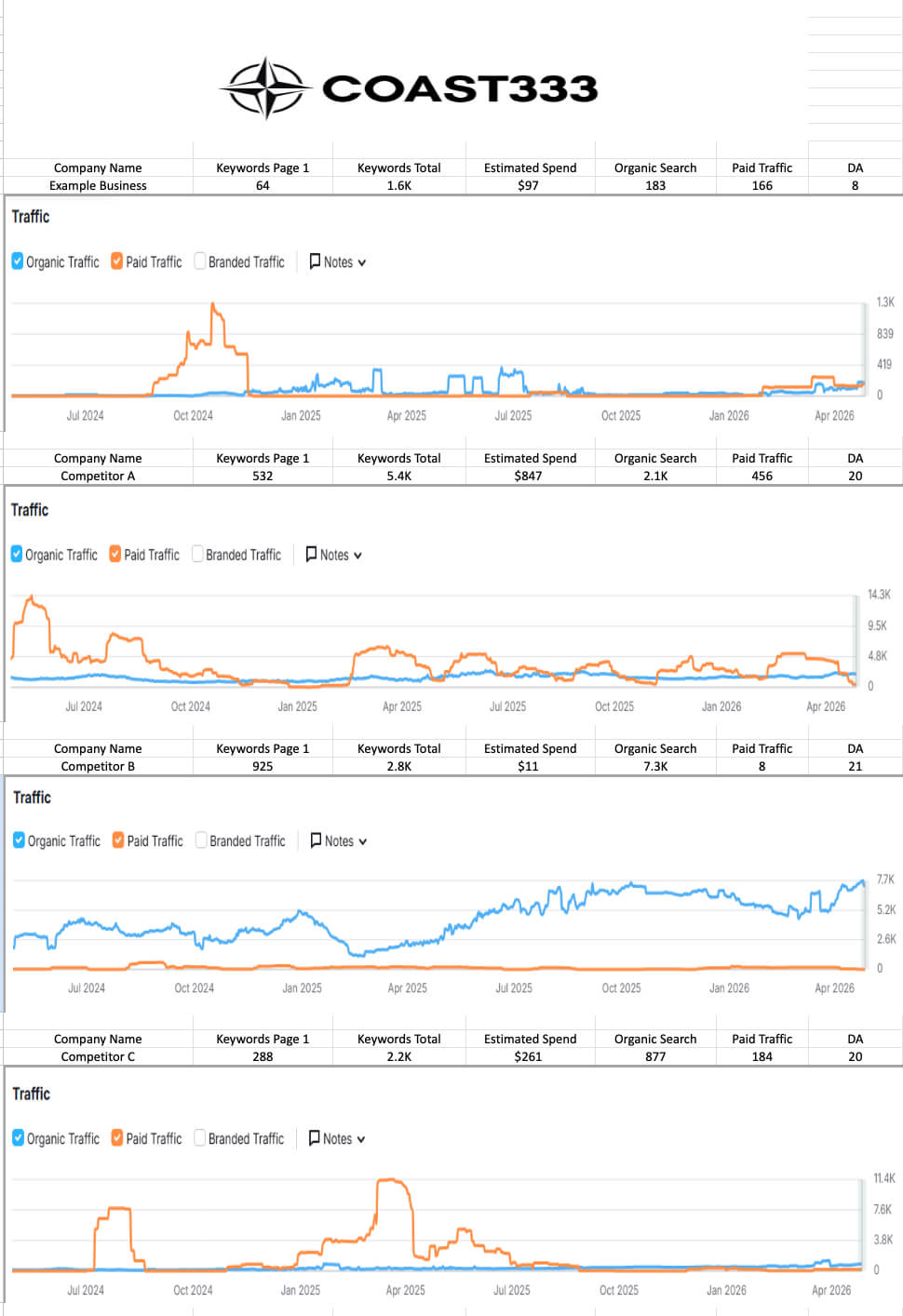
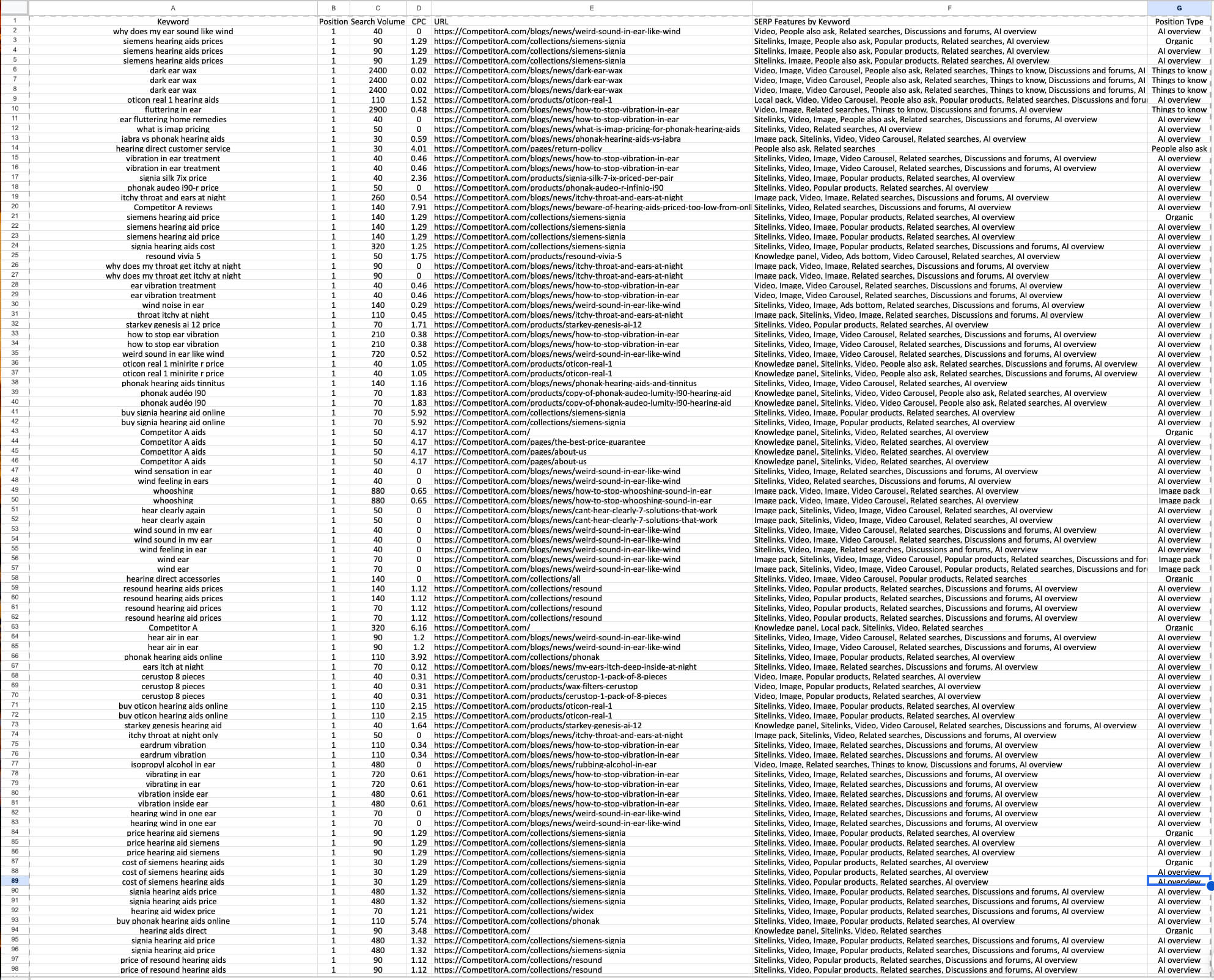
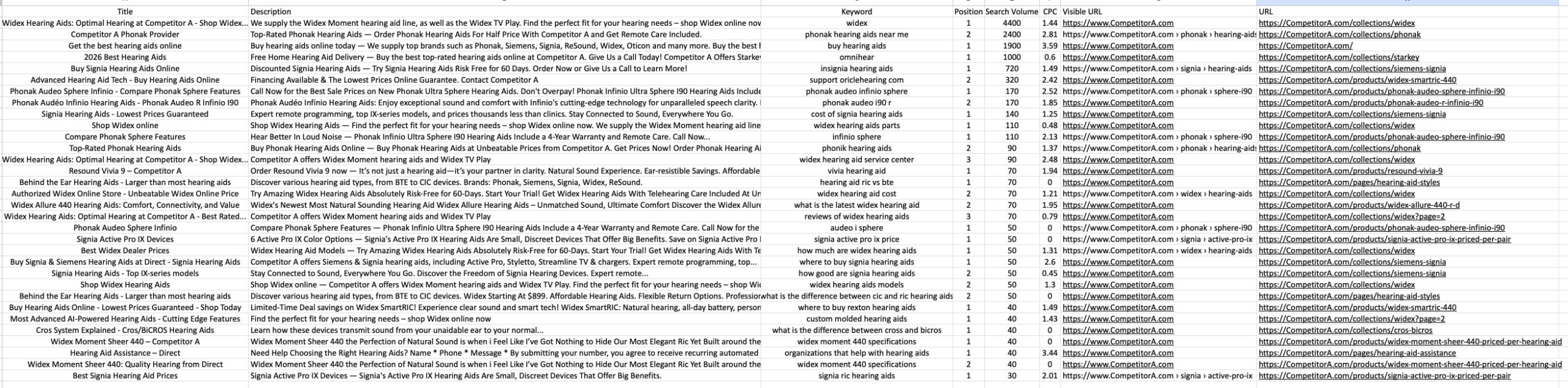
The exact research varies by business and market. What doesn’t vary: you keep the workbook, and you’re not left alone with a spreadsheet — we walk through it with you and turn it into an order of priorities.
Request your analysisStart with diagnosis
Request your Competitive Marketing Analysis.
A few details to get started. No card, no obligation, and you’re not committing to hire anyone — submitting this begins the process, and we’ll confirm which three competitors to review at the next step.
- Free
- No card required
- No obligation
- Findings are yours to keep
What happens next
-
01
Submit the basics
Tell us about your business, website and what you’re trying to improve.
-
02
Confirm the comparison set
We’ll invite you to a short conversation to confirm three relevant competitors and understand enough context about your market to make the research meaningful.
-
03
We do the research
A person builds the analysis, then we walk through the findings with you so you understand what the numbers mean and what deserves attention first.
How it runs
Four steps, and a person does the work.
No report generator, no automated scan. Our strategy team does the comparison by hand, because interpreting it is the part that matters.
Request
The short form above. Name, contact details, your business and website, and optionally what you’re most trying to improve. That’s the whole ask at this stage.
Confirm
We’ll invite you to book a short conversation to confirm which three competitors you want reviewed and give us context on your business and market. If you’re not sure who to name, we’ll help you choose — and we’ll say if the ones you picked aren’t the most useful comparison.
Analysis
Each of the three competitors is worked through across the six areas above, weighted to how your business wins customers. Prepared within 24 hours once the competitors being reviewed are confirmed.
Walkthrough
We go through the findings together, in priority order, and explain what they mean. Depending on calendars the walkthrough may land a few days out. You keep the document either way.
Straight answer
What this isn’t.
“Free analysis” is offered by a lot of people who mean something automated. Worth being precise about what this is not.
- An automated SEO grader
- A PageSpeed report
- A keyword dump
- A generic SWOT
- An arbitrary marketing score
- A 47-item problem list
- Manufactured urgency
- Guaranteed rankings
- Private competitor data
There’s no score, because a score would be made up. Nobody can compress a market position into a number out of a hundred, and the ones you see are chosen to look authoritative rather than to be right. What we produce is a comparison, an interpretation of it, and an order to work in.
We also can’t see inside anyone’s ad account or analytics. The work uses publicly observable signals and third-party estimates — which is enough to compare businesses meaningfully, and not the same thing as knowing exactly what a competitor spends.
Fit check
Worth your time if…
This is for you
- You’re not sure what to prioritise next
- Competitors seem to be pulling ahead and you can’t see why
- You’re spending on marketing without much clarity on what’s working
- Growth has flattened and the reason isn’t obvious
- You’re about to increase marketing investment
- You’re entering a new market, geography, product category or service area
- You’d rather decide from evidence than from a pitch
Probably skip it
- You want guaranteed rankings or overnight results
- You’re expecting competitors’ private financials or ad spend
- You want the work implemented inside a free analysis
- You’d rather not share enough context to interpret the findings
- You just want a price list for marketing services
- You’re not considering any marketing investment right now
Questions
Analysis FAQs.
Is this actually free?
Yes. No card, no trial, no catch.
We do these because a business that understands its market makes better decisions, and some of those businesses eventually hire us. Plenty don’t, and that’s fine — the findings are yours either way.
What happens after I submit the form?
You’ll be invited to book a short conversation. That’s where we confirm which three competitors to review and get enough context about your market for the findings to mean something. If you don’t book straight away, we’ll follow up — the form isn’t a commitment to anything.
How long does it take?
The analysis is prepared within 24 hours once the competitors being reviewed are confirmed. The walkthrough itself is scheduled around availability and may fall a few days out. We don’t start the clock at form submission, because at that point we don’t yet know who we’re comparing you against.
Which competitors do you analyse?
The ones you name — three keeps the findings sharp rather than sprawling. If you’re not sure who to pick, we’ll help you choose.
We’ll also say if the businesses you named aren’t the most useful comparison. The biggest company in your category often isn’t the right benchmark: in one analysis, two of the three competitors the owner named turned out to be national firms with search footprints hundreds of times larger, and the genuinely useful comparison was the third.
Do I get something in writing?
Yes. We walk through the findings live so nothing is ambiguous, and the document we worked from is yours afterward. Use it however you want, including without us.
Is this a sales call in disguise?
No. The walkthrough exists to review the analysis and explain what it shows about how those competitors compete for and convert customers.
If the findings point at something we could help with, we’ll say so — we’re not going to pretend otherwise. But the priority order is built around what deserves attention first, and sometimes that isn’t a service we sell. The analysis stands on its own whether or not you ever work with us.
Do I have to hire Coast333 afterward?
No. There’s no obligation and no contract attached to the analysis. You’ll have a clearer picture of how those competitors compete and where the gaps are, and what you do with that is entirely up to you.
Does this work for online stores and national businesses, not just local ones?
Yes. The six areas are the same; what changes is what matters most. A local service business usually turns on Maps visibility, reviews, local search and how well calls and forms convert. A regional or national business turns more on site structure, content depth and accumulated authority against a much wider field. E-commerce businesses usually turn on product and category visibility, Shopping, paid search and social, and how well the storefront converts visitors into purchases.
We adapt the emphasis to how you actually win customers — see industries we work in for how this differs by sector.
Start here
Pick three competitors.
That’s the whole ask. Fill in the short form, we’ll confirm who you want reviewed, and within 24 hours of that we’ll have worked through how each of them is competing for your customers — sorted by what deserves your attention first. More on how we think about this in what 12 real campaigns taught us, or browse the case studies.
No cost · No obligation · The findings are yours