
Industries · Law Firms
Law firm marketing doesn’t end when the phone rings.
Someone looking for a lawyer usually has a real problem and a short list. They have to find the firm, trust it enough to reach out, and then be answered well. We treat law firm marketing as that whole system — visibility, trust, contact and the handoff into intake — rather than a traffic number.
Visibility→Trust→ContactIntake→Consultation→Client
Why it’s different
A law firm isn’t a generic local business.
The mechanics look familiar — search, maps, ads, a website — but the decision behind them isn’t. Four things change how the marketing has to work.
- 01
The need is real, and often urgent
Someone searching “bankruptcy attorney near me” isn’t browsing. There’s debt, a diagnosis in the family, an arrest or an accident behind the search, and they want someone they can call.
- 02
Trust decides the shortlist
People choose between firms they’ve never met. Reviews, a credible profile and a site that explains the practice clearly do much of the persuading before anyone picks up the phone.
- 03
Clicks are expensive
Legal search terms are among the most expensive in paid advertising. In one of our published case studies, competitive terms in a major metro ran $20 to $60 per click. Precision matters more than volume.
- 04
The sale happens in intake
A call that goes unanswered or a form nobody follows up on is a lost client, however good the ad was. Marketing has to be judged alongside what happens after the inquiry.
The acquisition system
Six stages, and one handoff that decides the rest.
Every firm’s client acquisition runs through the same sequence. Marketing works most directly on the first three stages. The last three belong to the firm — but they’re where the marketing is ultimately judged.
- 01
Visibility
Does the firm appear when someone searches for the problem?
Breaks whenMaps visibility stops near the office, practice pages miss the searches, or paid search is priced out.
- 02
Trust
Does what they find make them comfortable reaching out?
Breaks whenReviews are thin, the profile is stale, or the site doesn’t show experience.
- 03
Contact
Can they reach the firm easily, and is it recorded?
Breaks whenNumbers are hard to find, forms are long, or calls and forms aren’t tracked.
- 04
Intake
Is the inquiry answered and qualified promptly?
Breaks whenCalls are missed, callbacks are slow, or nothing covers after hours.
- 05
Consultation
Does the right inquiry become a meeting?
Breaks whenPeople who aren’t ready yet never hear from the firm again.
- 06
Client
Does it become retained work?
Breaks whenReporting never gets this far, so nobody knows which marketing produced clients.
We don’t run a firm’s intake or its consultations, and we won’t pretend to control its close rate. What we do insist on is measuring across the handoff: tracked calls and forms, which inquiries were real, and what the firm can tell us about what happened next. Otherwise marketing gets judged on clicks — the wrong number.
Where it breaks
Where law firm marketing usually breaks.
Not every firm has these. They’re the failure points we look for first, because each one quietly caps what the rest of the marketing can produce.
Visible near the office, invisible across the service area
Clients drive in from well beyond one zip code. A firm can rank near its own address and disappear twenty minutes away — exactly where much of its demand lives.
01 · VisibilityBidding head-on for the most expensive terms
Competing only for the obvious, highest-cost keywords against firms with bigger budgets is an expensive way to be seen.
01 · VisibilityPractice-area pages that don’t match how people search
“Bankruptcy attorney,” “chapter 7 attorney” and “estate planning lawyer” can rank completely differently. One generic services page can’t answer all of them.
01 · 02A weak profile and thin reviews
A Google Business Profile set up once and left alone drifts, and a firm with few recent reviews loses the comparison before a prospect ever visits its site.
02 · TrustCalls and forms that aren’t tracked
Without call and form tracking, a channel can look excellent on traffic and cost per click and still produce almost nothing. Nobody can tell which spend is working.
03 · ContactInquiries lost after contact
Missed calls, slow callbacks and no plan for evenings and weekends waste demand the marketing already paid for.
04 · IntakeReporting that stops at clicks or raw leads
A lead count that includes wrong numbers, spam and people outside the practice area says little. Reporting should reach meaningful inquiries, and further where the firm can share it.
03 → 06
The strip beside each one shows where in the system it breaks. The dashed line marks the handoff into the firm’s own intake.
Practice area
Practice area changes the search.
An estate planning practice and a criminal defense practice can share a street and almost nothing else about how clients find them. These are tendencies we plan around, not rules.
| Practice area | How people tend to search | What usually carries the most weight |
|---|---|---|
| Personal injury | Soon after an incident, in some of the most competitive and expensive paid-search markets | Paid search control, call tracking, and economics tied to case value |
| Criminal defense | Urgently, often by phone, often outside business hours | Visibility at the moment of need, easy contact, and fast intake |
| Bankruptcy | Privately and specifically, “chapter 7 attorney” rather than “lawyer” | Local map visibility, clear practice pages, and trust signals |
| Estate planning, probate & elder law | Deliberately, often with family involved, with steady demand in retirement communities | Visibility across the full service area, reviews, and plain explanations |
| Family law | After a lot of private research, where privacy and tone matter | Trust, clear practice pages, and careful follow-up |
| Real estate law | Around a transaction, often alongside referrals | Local visibility and specific service pages |
Our published law firm proof is strongest in personal injury, bankruptcy and estate planning. For other practice areas, the same system applies, and we’ll be direct about where our experience is thinner.
Channels
The channels that matter, and when.
No firm needs all of these at once. The right mix depends on the practice area, the market and what the firm can handle — which is why we diagnose first.
- Google Ads and paid searchCaptures people already searching for a lawyer. Worth it when it’s tightly controlled — specific terms, clear ad copy, and every call and form tracked.Lead generation paid advertising
- Local Services AdsGoogle’s pay-per-lead format, available for some legal practice areas and markets. Useful where it’s offered and the firm can respond quickly to the leads it produces.
- Google Business Profile and local SEOOften the fastest place to gain ground for a local practice, and the one most firms leave half-finished.Local SEO
- Practice-area pages and organic searchPages built around what people actually search for each type of matter, supported by content that answers their real questions.SEO
- Paid social and remarketingBetter suited to building recognition and trust with a defined community, or staying present while someone decides, than to capturing urgent demand.Paid social
- Website and conversionA site that shows experience, explains each practice clearly, and makes contact simple on a phone.Web design & development
- Reviews and reputation signalsRecent, genuine reviews and a well-maintained profile carry a great deal of weight when prospects compare firms they’ve never met.
- Call and form trackingThe measurement that connects spend to real inquiries. Without it, every other channel is judged on guesswork.
Published proof
Three law firms, three different parts of the system.
Each case study covers a different firm, market and stage of client acquisition. The figures belong to their own case study and aren’t combined.
372%
Increase in average monthly leads
Winning expensive legal search without a bidding war.
The firm had a strong reputation, underperforming campaigns and almost no tracking, in a market where legal clicks ran $20 to $60. Instead of competing head-on for the most expensive terms, the strategy spread coverage across more than 2,000 long-tail keyword variations, rewrote ad copy around the firm’s track record, and added call tracking — which exposed a directory channel that looked excellent on paper and was almost entirely wasted spend.
- 27% lower average monthly ad spend
- 4.3 → 9 average monthly leads in the first month
- 12–20 conversions a week, online and phone
What it shows: in expensive legal markets, precise targeting and honest tracking can grow leads while spend falls.
Read the PPC case study55%
Share of local voice for “attorney bankruptcy chapter 7” after six weeks, up from 0%
From buried on the map to visible across the service area.
Our six weeks of focused profile work for a practice serving The Villages and surrounding communities. The firm ranked reasonably near its office on core bankruptcy terms but faded across the wider area, and was close to invisible on some high-value searches. Average position for “attorney bankruptcy chapter 7” went from 21 to 3.24.
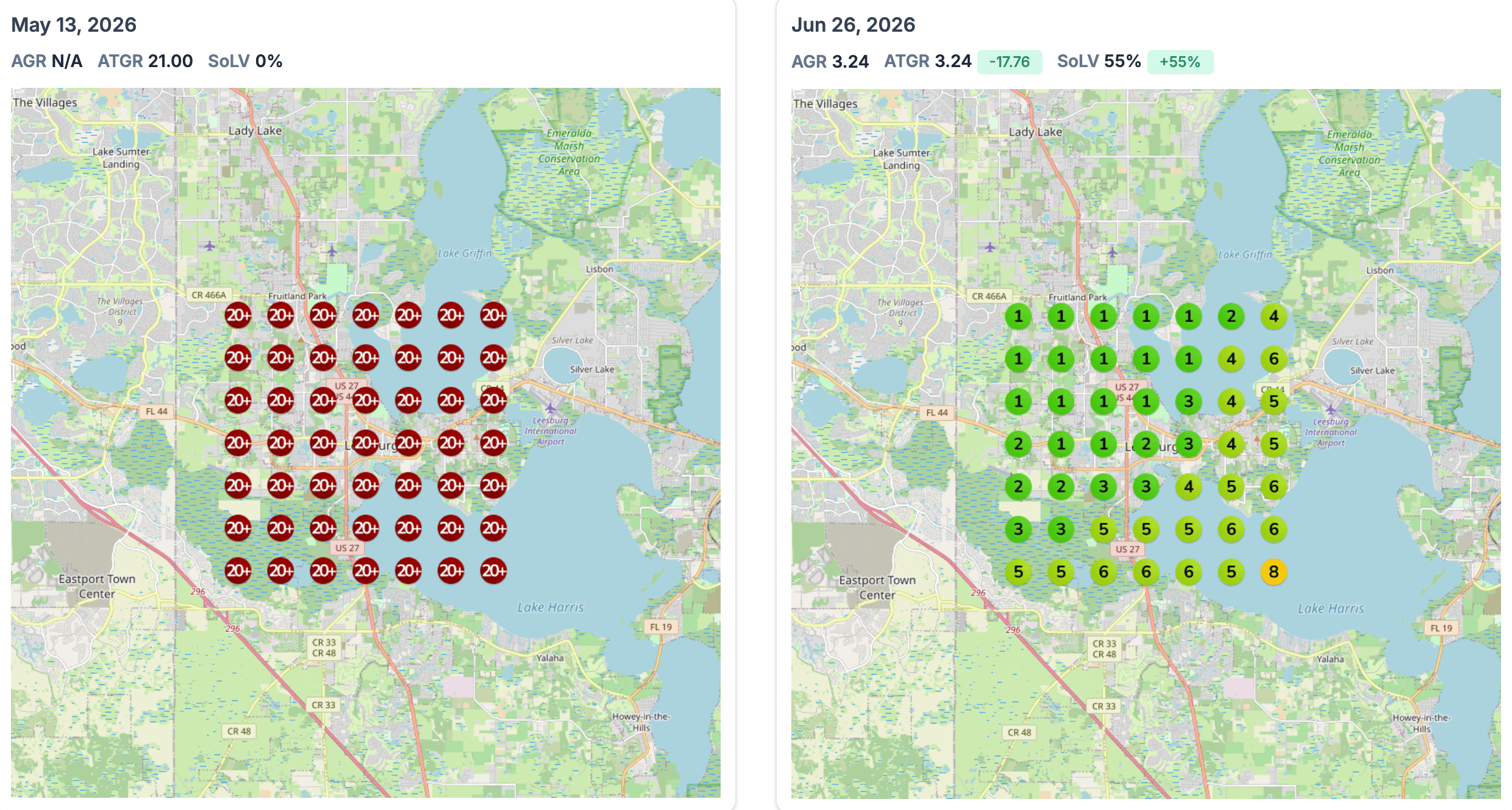
- +69% call clicks, 16 to 27
- +30% direction requests, 47 to 61
- 39% → 82% share of local voice, “bankruptcy lawyer”
What it shows: for a local practice, profile work can move visibility, trust and calls quickly — and has to be measured across the whole service area, not from the office.
Not every term moved as far. Broader estate planning and trust searches improved in position, but share of local voice only reached 10 to 14 percent. Higher-competition terms need more time.
Read the Google Business Profile case study20,000
New Facebook followers in 50 days
Building recognition with one specific community.
A firm focused on motorcycle accident cases wanted to be a name riders recognized and trusted across state lines. Paid and organic content was built around what that community actually engaged with, rather than around the firm, with the firm’s own articles woven in.
- 15% engagement per post, against a typical 1% or below
- +778% website traffic, June to September
- 14.88% bounce rate on traffic from social
What it shows: paid social can build the recognition and trust a firm needs before someone has a case — when it’s built around a real audience.
This case study reports followers, engagement and website traffic. It doesn’t report leads or cases, and shouldn’t be read as if it did.
Read the Facebook case studyResults depend on the market, practice area, competition and the firm’s own intake. Past results aren’t a promise of future ones.
How we approach it
Diagnosis before tactics.
The right channel for one firm can be the wrong spend for the next.
A law firm marketing agency should be able to tell you where your system is breaking before it recommends a channel. We start by looking at the firm, its market and its competitors, then recommend an order of work based on what the evidence shows. The mix depends on:
- Practice area
- Geography
- Competition
- Case value
- Search demand
- Existing authority
- Intake capacity
- Economics
- Growth goals
Sometimes the answer is paid search. Sometimes it’s the Google Business Profile, the practice-area pages or the reviews. Sometimes the most valuable thing is fixing how calls are answered before spending another dollar — and we’ll say so, even when it isn’t something we sell.
Attorney advertising is governed by rules that vary by state and practice. We write carefully and avoid claims about outcomes, but the firm remains responsible for compliance, and its own review should approve advertising before it runs.
Name three competing firms. We’ll show how they’re winning visibility and contact in your market, sorted by what deserves attention first.
Questions
Law firm marketing FAQs.
Do you work with my practice area?
We work with consumer-facing practices including personal injury, bankruptcy, estate planning, probate, elder law, family law, criminal defense and real estate law. Our published proof is strongest in personal injury, bankruptcy and estate planning. For other areas the same system applies, and we’ll be direct about where our experience is deeper or thinner.
Can you guarantee cases, clients or rankings?
No. No honest agency can. Results depend on the market, competition, practice area and how the firm handles the inquiries it receives. What we can commit to is clear diagnosis, careful execution and reporting that shows what’s actually happening.
Is Google Ads worth it for a law firm, given how expensive clicks are?
It can be, when it’s controlled tightly. The expensive failures usually come from bidding head-on for the broadest terms and not tracking which clicks become real inquiries. Specific targeting, credible ad copy and call tracking change the economics considerably, as the law firm PPC case study above shows.
Do you handle intake or answer calls for the firm?
No. Intake stays with the firm. We track calls and forms, report on which inquiries were real, and flag it when inquiries appear to be getting lost after contact — because that’s often where marketing results are actually decided.
What about attorney advertising rules?
Rules vary by state and practice, so we avoid outcome claims and write conservatively. The firm remains responsible for compliance, and its own review should approve advertising before it runs. We don’t provide legal advice on those rules.
Do you work with solo attorneys and small firms?
Yes. Many of the most useful gains for small practices come from the Google Business Profile, practice-area pages and tracking rather than large ad budgets. The right starting point depends on the market and what the firm can handle.
How do you measure success for a law firm?
By tracked calls and forms, then by which of those were real inquiries in the practice area, and as far past that as the firm can share — consultations and retained clients. Clicks and impressions are diagnostic, not the goal.
Next step
Find out where your firm’s system is breaking.
A Competitive Marketing Analysis compares your firm with three competitors you name — search visibility, paid activity, profile and reviews, and how easily prospects can reach each firm — then sorts the findings by what deserves attention first. It’s free, and the findings are yours.