

From Buried on the Map to Ranking in the Top Three: A Google Business Profile Case Study
How a Central Florida estate planning and bankruptcy firm rebuilt its Google visibility across Lake and Sumter County.
Introduction
For a solo or small law practice, showing up on Google is not a nice to have. It is often the difference between the phone ringing and the phone staying quiet. When someone searches “bankruptcy attorney near me” or “estate planning lawyer,” they usually are not browsing. They have a real situation in front of them: debt that has gotten out of hand, a parent who needs a trust set up, a will that never got finished. That kind of search carries about as much intent as local search gets.
This case study looks at what happened over roughly six weeks of focused Google Business Profile work for a Central Florida estate planning and bankruptcy law practice serving The Villages, Lady Lake, Fruitland Park, and the surrounding Leesburg area. We are not using the firm’s name here. What matters is the pattern, because we see versions of it across a lot of local service businesses, not just law firms.
The Challenge
Local legal markets in Central Florida are unusually competitive, especially anywhere near The Villages. A retirement community of that size creates constant, steady demand for estate planning, trusts, elder law, and bankruptcy work. That demand also means every attorney within thirty miles is competing for the same handful of map pack spots.
A few things make this particular kind of visibility hard to win.
- A law firm’s real service area is not one zip code. The Villages spans three counties, and clients will drive from Fruitland Park, Wildwood, Leesburg, and beyond. Ranking well only near the office does nothing for the client who lives twenty minutes away.
- Legal search terms split into a lot of variations. “Bankruptcy attorney,” “bankruptcy lawyer,” “chapter 7 attorney,” “estate planning,” “estate planning attorney,” “trust attorney,” “wills and trusts.” Each of those can rank completely differently, so a firm can look strong on one term and be invisible on the next.
- Google Business Profile visibility is not static. It moves with review activity, category settings, information consistency, and ongoing signals that the profile is active. A profile set up correctly two years ago and never touched since will usually drift.
For a firm competing in a market like this, the real question is not whether it shows up on Google Maps. Almost everyone does. The question is whether it shows up across the geography where its actual clients live, on the terms that actually describe what it does.
Initial Situation
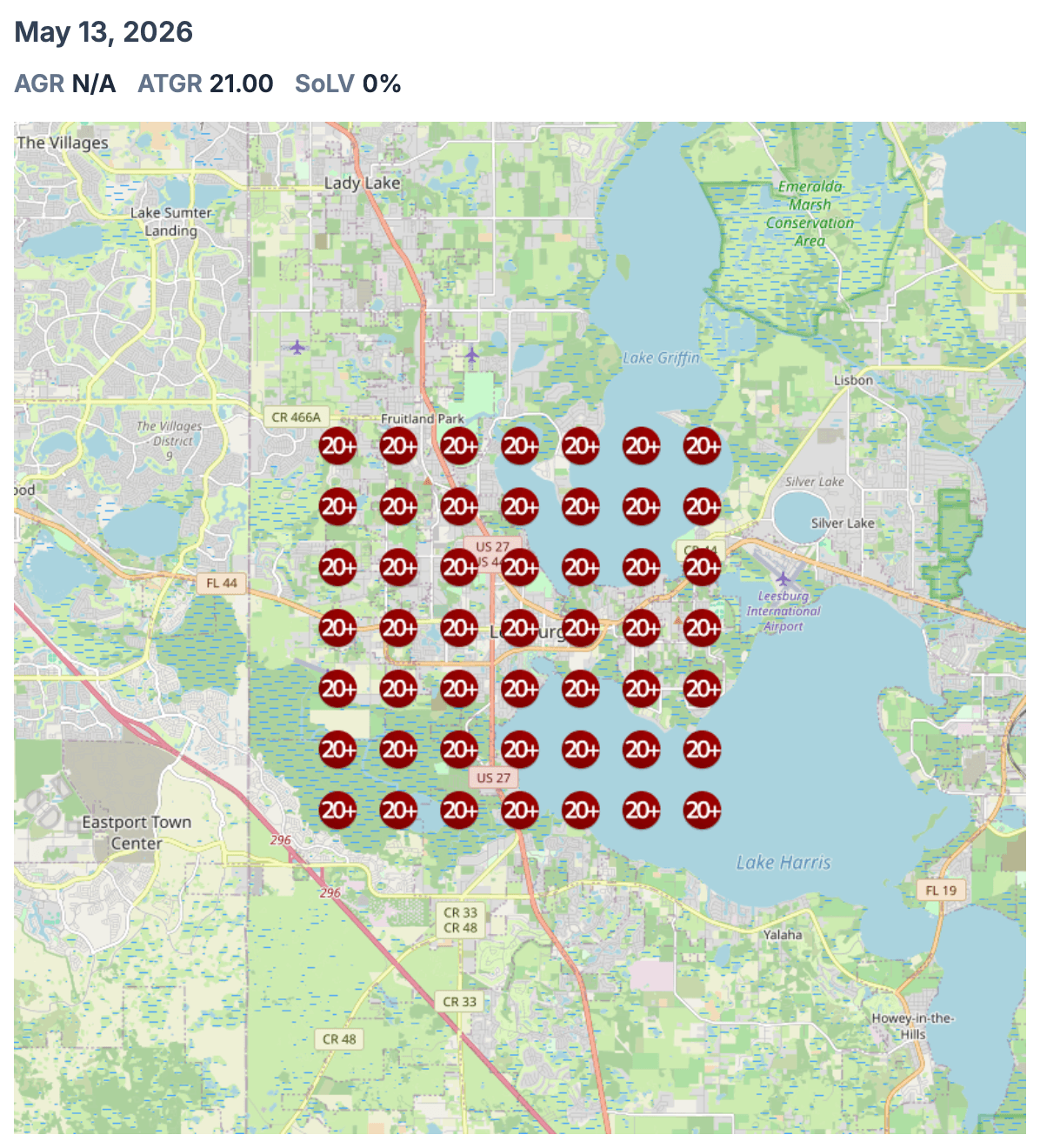
Looking at where this firm’s Google Business Profile performance and rankings stood in mid-May, a few patterns stood out.
- On core bankruptcy terms, like “bankruptcy attorney” and “bankruptcy lawyer,” the firm already ranked reasonably well near the center of its service area, in the 4 to 5 average position range. But that visibility fell off quickly outside the immediate area. Share of local voice, meaning the percentage of the tracked service area where the firm actually appeared in the map pack, sat around 39 percent for both terms.
- On “attorney bankruptcy chapter 7,” the firm had almost no visibility at all. Average position across the tracked grid was 21, and share of local voice was 0 percent.
- On broader, higher competition terms like “estate planning,” “trust attorney,” “trust lawyer,” and “wills and trusts,” the picture was tougher. Average positions across the service area ran from 12 to over 16, and share of local voice was in the low single digits, in a couple of cases 2 percent or less.
- Customer actions were moving but modestly, and desktop map impressions in particular were low, only 20 over the prior 30-day period.
None of that reflects poorly on the firm. Sole and small law practices are busy running cases, not managing a Google profile day to day. This is simply what a lightly managed profile tends to look like in a market this competitive: solid where it counted most, thin almost everywhere else, and close to invisible on some of the highest value search terms.
Our Strategy
Once we started working the profile, our approach followed the same framework we use for any local business trying to build durable visibility, not a short-term bump that fades in a month.
Category and profile optimization
Google Business Profile visibility starts with how a business describes itself to Google, not just to potential clients. That means primary and secondary categories that match real search behavior, service descriptions written in the language people actually search with, and details that stay consistent across every field. For a law firm, precision matters here. “Bankruptcy attorney” and “estate planning attorney” are treated as different services in Google’s eyes, even when one firm handles both.
Relevance and authority
Ranking well on Maps is not just about the address pin. Google weighs relevance, meaning how well a business matches the search, distance, meaning how close it is to the person searching, and prominence, meaning how established and trusted the business appears to be. All three matter, but relevance and prominence are usually where the fastest, most controllable gains come from for a firm that already has a real, established location.
Consistency over time
A profile that gets touched once and left alone tends to plateau or slide backward. Ongoing optimization, meaning regular attention to the profile rather than a one-time setup, signals to Google that a business is active. That matters even more in a competitive market, where every other firm nearby is also making moves.
GeoGrid tracking across the full service area
Instead of just checking where a business ranks from one point, we track rankings across a grid of points spanning the entire service area, for each core keyword. That is the only way to know whether a firm is visible just near its own office or genuinely visible across the market it is trying to serve. For a firm serving a spread out retirement community, that distinction is not academic. It is the whole game.
Measuring business outcomes, not just rankings
A position on a map means very little if it never turns into a call, a click, or a direction request. Every optimization gets measured against the outcomes that actually matter to the business, not against ranking numbers in isolation.
We want to be straightforward about one thing here. In a market like this, most of these gains come from patient, layered work rather than a single fix. Where something cannot be confirmed directly from the data, we are not going to claim it happened. What we can say is that this is the strategy we apply consistently, and the results below reflect roughly six weeks of it in motion.
The Results
By late June, the difference was visible in both the customer action metrics and the underlying rankings.
Customer actions
| Metric | Prior 30 Days | Latest 30 Days | Change |
|---|---|---|---|
| Call clicks | 16 | 27 | +69% |
| Website clicks | 27 | 30 | +11% |
| Direction requests | 47 | 61 | +30% |
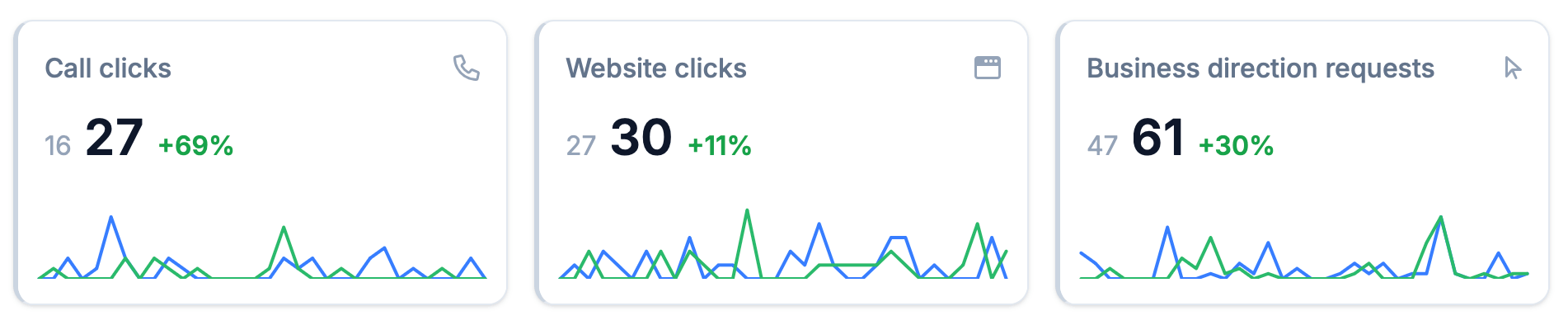
Call clicks jumping 69 percent is the number that matters most here. A direction request or a website click can still be someone comparing options. A call click is usually someone ready to talk. For a firm doing bankruptcy and estate planning work, more calls is the entire point of doing any of this.
Direction requests climbing 30 percent, from 47 to 61, tells a related story. People were not just seeing the business. They were planning to show up in person, which fits a legal practice where the first real conversation often happens face to face.
Visibility on Maps and in search
| Impression Type | Prior 30 Days | Latest 30 Days | Change |
|---|---|---|---|
| Desktop maps impressions | 20 | 53 | +165% |
| Desktop search impressions | 218 | 225 | +3% |
| Mobile search impressions | 328 | 368 | +12% |
| Mobile maps impressions | 56 | 61 | +9% |
Business impressions on desktop maps rose 165 percent, by far the largest shift in the data. That lines up with what we would expect from GeoGrid based work: as a business starts showing up across more of its service area instead of just near its own address, the raw number of times it gets surfaced on Maps searches climbs sharply, even before any of those impressions turn into a click. Mobile maps impressions moved more modestly, up 9 percent, and both search impression categories were up single digits to low double digits. Those numbers were already fairly strong to begin with, so smaller percentage gains there still represent meaningful volume.
Keyword rankings and share of local voice
This is where the six weeks of work shows up most clearly, and it is also where the honest, nuanced story lives. Every one of the ten tracked keywords improved in average position. But the improvements were not uniform, and that unevenness is instructive on its own.
| Keyword | Avg. Position May 13 | Avg. Position Jun 26 | SoLV May 13 | SoLV Jun 26 |
|---|---|---|---|---|
| Attorney bankruptcy chapter 7 | 21.00 | 3.24 | 0% | 55% |
| Bankruptcy attorney | 4.82 | 2.35 | 39% | 78% |
| Bankruptcy lawyer | 4.29 | 2.33 | 39% | 82% |
| Elder law attorney | 7.51 | 3.16 | 14% | 55% |
| Estate planning | 14.76 | 9.63 | 8% | 10% |
| Estate planning attorney | 11.55 | 6.76 | 10% | 14% |
| Estate planning lawyer | 14.24 | 8.29 | 4% | 10% |
| Trust attorney | 15.10 | 7.47 | 2% | 14% |
| Trust lawyer | 16.22 | 6.45 | 2% | 14% |
| Wills and trusts | 21.00 | 8.31 | 0% | 10% |
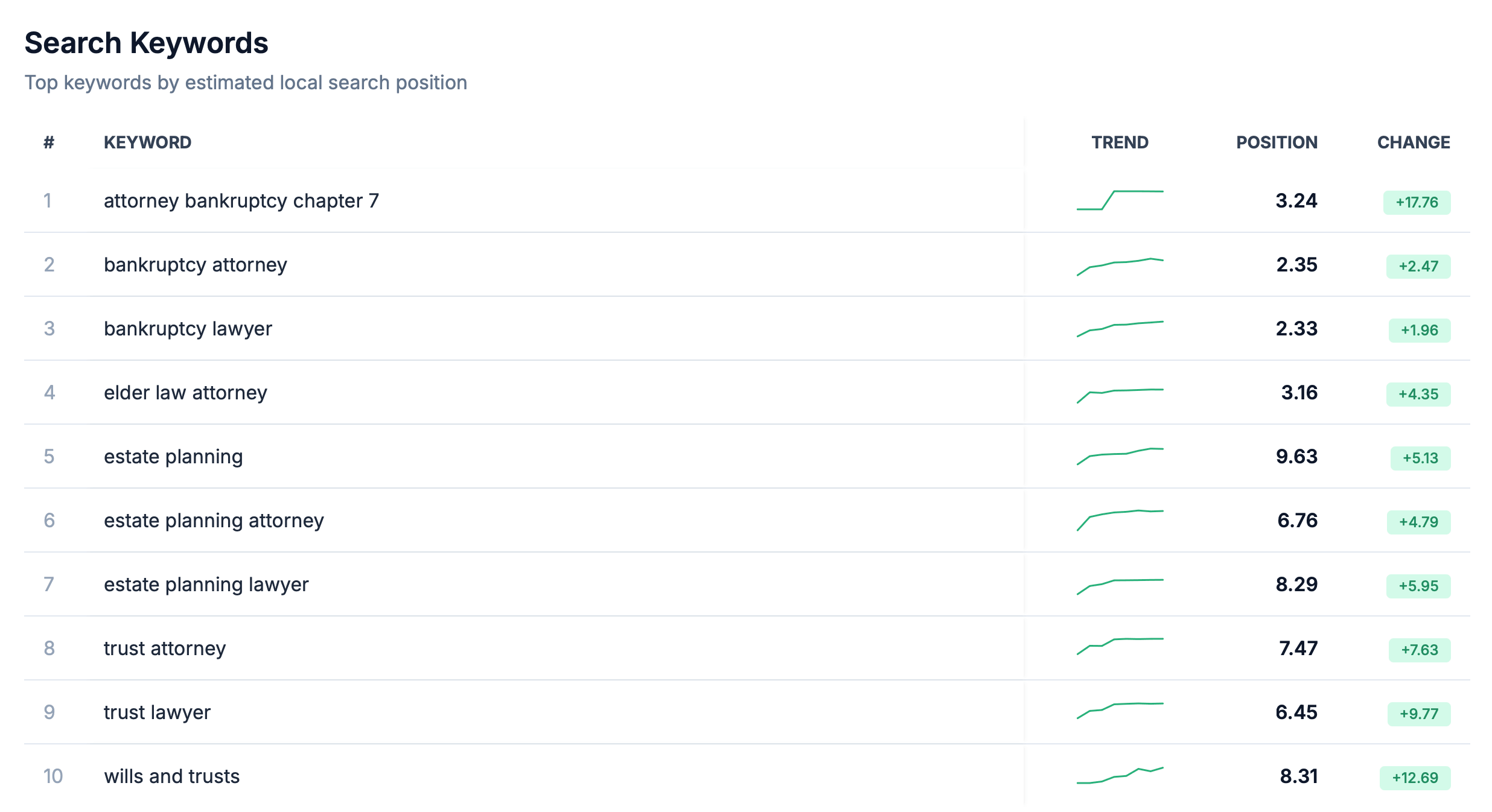
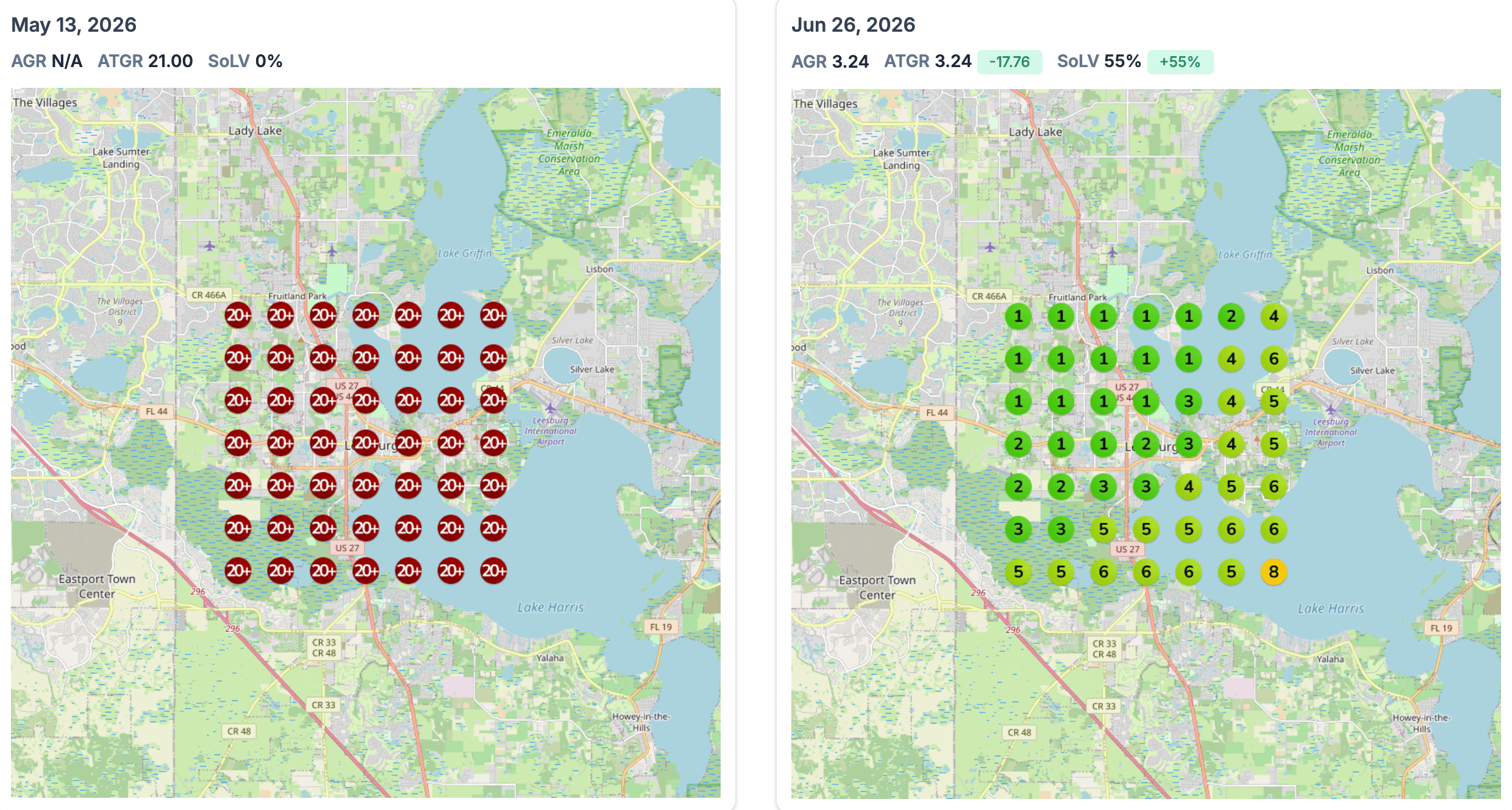
The bankruptcy related terms moved the fastest and the furthest. “Attorney bankruptcy chapter 7” went from essentially invisible to an average position of 3.24, with share of local voice jumping from 0 to 55 percent. “Bankruptcy attorney” and “bankruptcy lawyer” both moved into solid top three territory on average, with share of local voice reaching 78 and 82 percent. In plain terms, the firm went from being visible near its own address on those terms to being visible across most of its actual service area.
The broader terms tell a different, more honest story. “Estate planning,” “trust attorney,” and “trust lawyer” all improved in average position, in some cases cutting the position roughly in half. But share of local voice on those terms only moved from the low single digits into the 10 to 14 percent range. These are higher volume, higher competition terms, and six weeks of work moved them in the right direction without fully solving them. That is a realistic outcome, not a disappointing one. It also happens to be the more useful lesson for other business owners, which we get into next.
What Business Owners Can Learn
- Local SEO compounds, but on a timeline measured in months, not days. Six weeks was enough to move core terms into strong territory and to meaningfully improve broader terms without fully solving them.
- Rankings only matter if they turn into activity. Call clicks and direction requests are the real scoreboard, not the position number by itself.
- Consistency matters more than a one-time fix. A profile that gets attention on an ongoing basis behaves differently than one that gets set up once and left alone.
- Maps visibility across the whole service area matters as much as position at the center of the map. A great ranking near the office is worth little if it disappears twenty minutes away, which is exactly where a lot of real clients live.
- Google Business Profile is an ongoing asset, not a listing you set up and forget. It behaves more like a piece of infrastructure that needs maintenance than a form you fill out once.
- Visibility should lead to qualified interactions, not just more traffic. The goal was never more impressions for their own sake. It was more calls from people who actually need the service.
Final Thoughts
None of this is complicated, and none of it happened overnight. It is the result of treating a Google Business Profile like an asset that needs ongoing attention rather than a listing you set up once and check on when business slows down.
If you run a local business and you are not sure whether your own Google visibility reaches as far as your actual service area, that is exactly the kind of question a Competitive Marketing Analysis is built to answer. It is free, it takes a look at where you actually stand, and there is no pressure attached to it either way.